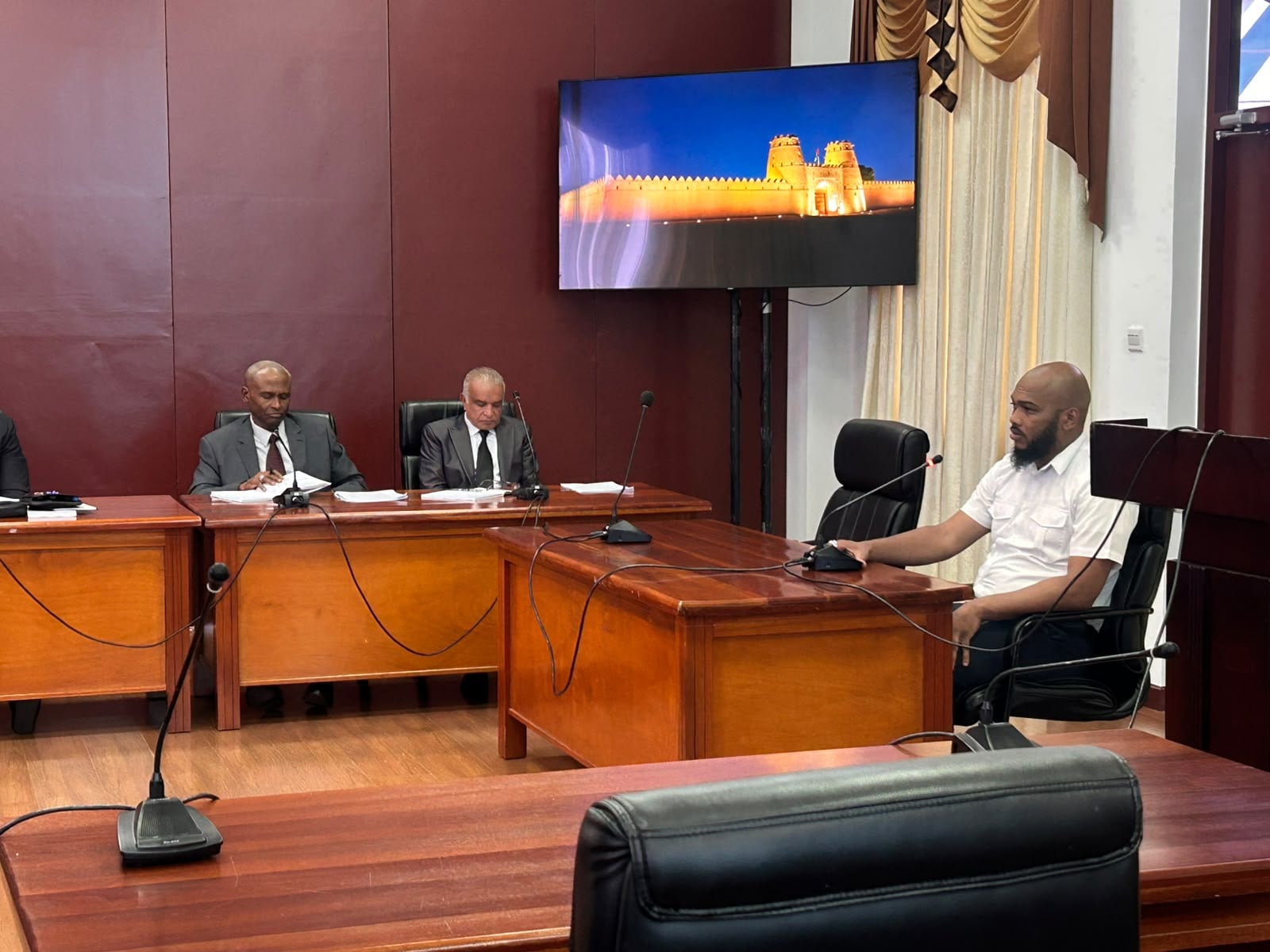
Marine officer and ship surveyor Christopher Bailey told the MV Barima Commission of Inquiry that an emergency beacon he recovered at sea deactivated immediately when he brought it aboard his vessel.
Commissioners questioned Bailey about the device’s location, protective casing and activation, including whether its first distress transmission could indicate when it became submerged.
Bailey testified that he spotted a faint light in the water between approximately 3.30 am and 4 am during search operations. On approaching it, he discovered that it was an emergency position-indicating radio beacon (EPIRB).
The device was not attached to debris, the vessel or a life raft, he said.
“I took it out. It deactivated immediately,” Bailey testified, adding that he had neither activated nor deactivated it himself.
He retained the beacon before handing it over to Captain John Flores, MARAD’s Coordinator of Emergency Operations, at the Maritime Rescue Coordination Centre (MRCC).
During questioning, commissioners sought to establish how the device could have been released from its protective casing and activated in the water.
Bailey explained that it was designed as a float-free beacon, capable of being released from its housing when submerged and floating to the surface to transmit a distress signal.
He said that during an earlier inspection of the Barima, he had seen a beacon in a white waterproof case on the starboard side near the wheelhouse, to the right when exiting the wheelhouse door.
Asked whether the first distress signal, received at 10.43 pm on July 18, indicated that the beacon had already been submerged, Bailey said that was possible but he could not confirm it.
The commission also examined a sticker on the recovered device instructing the user to complete registration. Bailey said manufacturers placed such labels on beacons to remind purchasers to register them, although he could not explain the precise wording.
Bailey further testified that he found three fully inflated life rafts during the search, but none contained survivors or bodies.
He said that at approximately 4.30 pm, the Harbour Master called to inform him that survivors had been found. His vessel subsequently assisted in transferring survivors to another pilot vessel for transport to the Coast Guard base for medical attention. He estimated that approximately 50 survivors were involved.
On July 20, two days after the sinking, his team encountered approximately 15 to 20 bodies floating off the Pomeroon Beach area, Bailey said. He recorded their coordinates using his personal GPS device and relayed the information to the MRCC.
Under further questioning, Bailey said he believed he still had GPS records of his movements during the operation and agreed to provide the relevant position data to the commission.
He also said that, to his knowledge, no post-incident briefing had been held to review the overall search-and-rescue operation, including its successes and failures.
Bailey is expected to return to give further evidence about his role in inspections of the MV Barima.









Discussion