
Justice Damone Younge has dismissed a constitutional challenge brought by APNU’s lead Member of Parliament Terrence Campbell against the appointment of the members of the Teaching Service Commission (TSC), ruling that President Irfaan Ali was entitled to proceed with the appointments despite not consulting a Leader of the Opposition because the office was vacant at the time.
In a decision, made public by the office of the Attorney General, the court found that the absence of an elected Opposition Leader made consultation under Article 207(2)(d) of the Constitution impossible and therefore did not invalidate the appointments.
Campbell, through his lawyers Khemraj Ramjattan and Christopher Ram, had sought declarations that the appointments were unconstitutional, unlawful and void on the basis that Article 207(2)(d) requires the President to appoint three members of the TSC only after “meaningful consultation” with the Leader of the Opposition. He argued that since no Opposition Leader had been elected when the appointments were made on December 31, 2025, the constitutional process had not been followed.
Attorney General Anil Nandlall SC, however countered this argument by pointing out that consultation was impossible because the office of Opposition Leader had been vacant since July 4, 2025 and that the President could not be prevented from constituting the commission indefinitely.
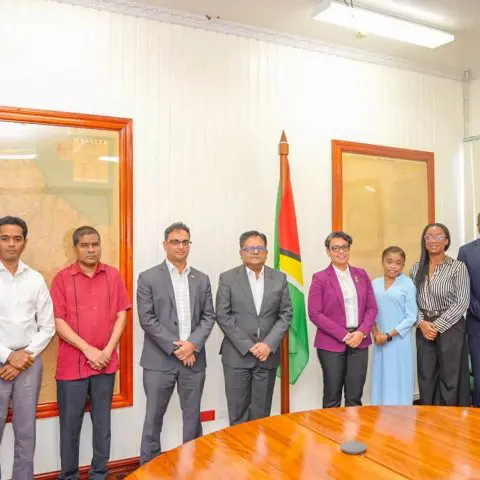
On December 31, 2025 President Ali swore in seven members of the Teaching Service Commission at the Office of the President: Doodmattie Singh, Shafiran Bhajan, Joan Davis-Monkhouse, Lancelot Baptiste, Satti Jaisierisingh, Mayda Persaud, and Saddam Hussain.
Following the ceremony, the President told the Department of Public Information (DPI) that the appointments could not be delayed. DPI quoted him as saying that while Article 207(2)(d) provides for meaningful consultation with the Leader of the Opposition, the absence of such a leader does not mean constitutional bodies should remain inactive.
Central issue
Justice Younge identified the central issue as “whether the absence of consultation with the Leader of the Opposition vitiated the exercise of the President’s appointing power pursuant to Article 207 (2)(d) of the Constitution, rendering the appointments of the members of the Teaching Service Commission unlawful.”
While acknowledging that the Constitution imposes a duty on the President to meaningfully consult the Opposition Leader before appointing three members of the commission, the judge found that established case law supported the position that consultation is required only when it is capable of taking place.
“The authorities have clearly established that the constitutional obligation to consult arises only in circumstances where all relevant actors have been duly elected or appointed,” Younge stated. “The duty is not absolute in its application, but rather contingent upon the practical possibility of engagement.”
The court relied heavily on earlier rulings, including Christopher Jones v the Attorney General and Clifton Hicken, in which then Chief Justice Roxane George held that meaningful consultation cannot be breached where consultation is impossible.
Quoting from that judgment, Justice Younge noted that “there could be no disregard and thereby a breach of the requirement for meaningful consultation when it was impossible to so engage.”
The judge observed that the office of Opposition Leader had remained vacant from July 2025 through the date of the appointments and that there was “no way of knowing” when it would be filled.
“There was therefore no one with whom the President could have consulted between July and December 2025,” the ruling said.
Rejecting Campbell’s argument that the President’s power to appoint did not arise at all in the absence of consultation, Justice Younge held that the inability to consult did not extinguish the constitutional authority to make appointments.
“The fact that the President was unable to consult with the Leader of the Opposition prior to making the appointments to the Commission does not mean that the power to appoint under Article 207 (2) (d) does not arise at all nor does this preclude him from acting,” the judge stated.
The ruling also emphasized the importance of maintaining the operation of constitutional bodies, noting that delaying the appointments could have adversely affected the education sector.
“The administration of education in Guyana remains a vital pillar of national life. To leave the system without a functioning Commission would have exposed it to uncertainty and disruption, thereby imperilling the orderly governance of the sector,” Younge wrote in the decision.
The Fixed Date Application filed by Campbell on January 19, 2026 was dismissed. Given what the court described as the public-interest nature of the proceedings, Justice Younge ordered that each side bear its own legal costs.
Despite
Campbell had earlier pointed out that despite the 13th Parliament having convened its first sitting on November 3, 2025; Speaker Manzoor Nadir had not summoned the perfunctory meeting required for opposition MPs to elect a Leader of the Opposition. There is no public record, he had said, of any effort by the President or the government to encourage the Speaker to facilitate that process.
He had further noted that on February 3, 2025, Vice President Bharrat Jagdeo publicly stated that once a Leader of the Opposition was elected, the remaining service commissions would be constituted. Campbell argued that the President’s subsequent decision to appoint members to the TSC without consultation therefore also contradicts the government’s own previously stated position.
Campbell had said too that the appointments set a dangerous precedent, weaken constitutional checks and balances, and erode parliamentary democracy.
“I call on all Guyanese to recognise the importance of robust parliamentary participation and to stand firm against actions that dilute constitutional rights,” Campbell had said at the time.
It was not until January 26th, weeks after the 13th Parliament was opened in November 2025 and following urgings from the diplomatic community that Speaker Nadir convened the meeting that ultimately resulted in leader of the We Invest in Nationhood Azruddin Mohamed was sworn in as Opposition Leader.










Discussion