
-acknowledges he should have confined himself to public commentary
CCJ President, Justice Winston Anderson yesterday admitted involvement in trying to secure agreement for the substantive appointments of a Chancellor of the Judiciary and Chief Justice here and acknowledged he should not have done this.
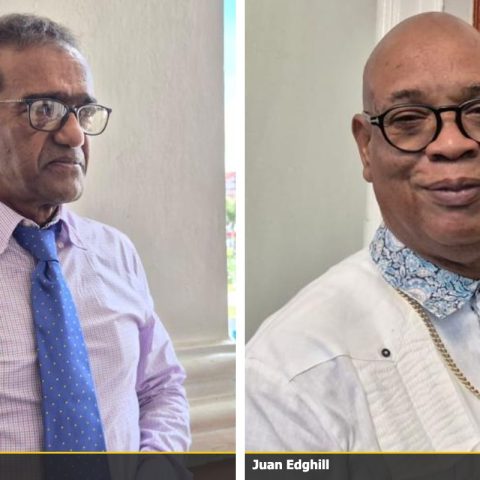
Justice Anderson addressed the matter in a lengthy statement following allegations by former Opposition Leader Aubrey Norton that the Caribbean Court of Justice (CCJ) President had sought his agreement to the appointment of then acting Chief Justice Roxane George-Wiltshire as Chancellor and Justice Navindra Singh as Chief Justice.
His acknowledgment could be another piece in the puzzle surrounding the hasty departure of the former Chancellor, Justice Yonette Cummings-Edwards who resigned one day after returning from leave.
“Looking back, I recognise that another course would have been much better,” Justice Anderson said. “It may have been better to have confined myself to public commentary on the constitutional importance of substantive judicial appointments, as did my predecessors.”
He nevertheless maintained that his involvement was motivated solely by concern for judicial independence and the constitutional integrity of Guyana’s judiciary.
“For more than two decades, Guyana has been without substantively appointed holders of its two highest judicial offices,” Justice Anderson said. “This is a concern that did not originate with me, nor is it a concern directed at any particular Government, political party, or individual.”
Guyana has been without a substantively appointed Chief Justice since 2001 and Chancellor since 2005.
Article 127 of the Constitution requires the President to obtain the agreement of the Leader of the Opposition before making substantive appointments to the two offices. Successive presidents and opposition leaders have failed to reach agreement.
Justice Anderson said prolonged acting appointments sat uneasily with the constitutional safeguards intended to protect the judiciary from political and executive influence.
“Such appointments inevitably create a structural vulnerability which is difficult to reconcile with the constitutional promise of complete judicial independence,” he said.
He cited Article 122A(1), which provides that the courts and persons presiding over them must exercise their functions independently of the control or direction of any person or authority.
The CCJ President said he had no personal preference concerning who should be appointed.
“Let me be clear. I have no personal interest or preference in who is appointed Chancellor or Chief Justice of Guyana,” he said. “My concern has always and only been confined to the constitutional principle that the judiciary should be headed by substantively appointed office holders enjoying the full constitutional protections intended by the framers of the Constitution.”
Justice Anderson noted that his predecessors had repeatedly criticised the failure to fill the offices substantively.
He recalled that former CCJ President Sir Dennis Byron told the Guyana Bar Association in 2013 that Article 127 imposed an obligation on the President and Opposition Leader to reach agreement. Sir Dennis had said the continued failure to make the appointments had exceeded what should be accepted in a modern constitutional democracy.
Justice Anderson also cited former CCJ President Justice Adrian Saunders, who described the absence of confirmed appointments in 2022 as “one significant blot on an otherwise impressive Guyanese legal and judicial landscape.”
“My own position therefore reflected the position consistently expressed by successive Presidents of the Caribbean Court of Justice,” Justice Anderson said.
He related that during an official visit to Guyana, accompanied by senior CCJ officials, courtesy calls were paid on President Irfaan Ali, Attorney General Anil Nandlall SC, the Director of Public Prosecutions and representatives of the parliamentary opposition.
Justice Anderson said opposition representatives expressed concern that any appointments should be made strictly in accordance with the Constitution and should not create a perception that the established arrangements were being circumvented.
“Those concerns, I believe, reflected the hard realities surrounding the issue and illustrated the difficulty that had prevented agreement from being reached over twenty years,” he said.
Justice Anderson confirmed that he later spoke separately with Ali and Norton in October 2025 in an attempt to resolve the impasse.
“I sought, privately and in good faith, to encourage progress towards resolving the impasse,” he said. “Those discussions were frank and undertaken solely in the interests of the administration of justice and judicial independence. They did not produce the outcome I had hoped for.”
Several times
His statement followed an interview reported in Kiskadee Watch in which Norton stated that Justice Anderson contacted him several times and asked whether he would agree to the proposed appointments of Justices George-Wiltshire and Singh.
Norton said Justice Anderson told him that then acting Chancellor Cummings-Edwards had agreed to leave office and was satisfied with a package offered by the government.
Norton said he questioned how Justice Anderson knew about the purported arrangement and was told that the CCJ President had participated in or facilitated the negotiations.
“I found that strange. I found it odd that he should be involved in that,” Norton said.
He related that he sought information through someone close to Justice Cummings-Edwards and was not satisfied that she was entirely comfortable with the arrangement.
“To me, that was involuntary, and so I said at that point I’m not comfortable with it,” he said.
Norton also said that during a subsequent conversation, Justice Anderson told him that the President and others were waiting to swear in the proposed appointees. Norton said Justice Anderson indicated that he had been with Ali.
“I found that strange,” Norton said. “I then said that I will get back to him, and then I stopped taking his calls.”
Norton further alleged that Justice Anderson referred to Justice George-Wiltshire being Afro-Guyanese and suggested that agreeing to the appointments would allow him to place his name “in the history books” by ending the longstanding stalemate.
He said he rejected that consideration and regarded Justice Anderson’s involvement as an overreach into Guyana’s political and constitutional affairs.
“My concern with Justice Anderson, while I was dealing with him, had to do with what I perceived to be his involvement in Guyanese politics, when he should be an impartial arbiter,” Norton said.
Justice Anderson’s statement did not specifically address Norton’s allegations about the retirement package, the reference to Justice George-Wiltshire’s ethnicity or the assertion that officials were waiting to conduct the swearing-in.
He rejected, however, any suggestion that he was motivated by political or personal considerations.
“My only concern has been the preservation of judicial independence and the constitutional integrity of the Guyanese judiciary,” Justice Anderson said.
He added that his actions were not driven by “any political or other preference, personal interest, or any desire to intervene in the domestic affairs of Guyana” beyond what he considered his responsibility as President of the country’s final appellate court.











Discussion