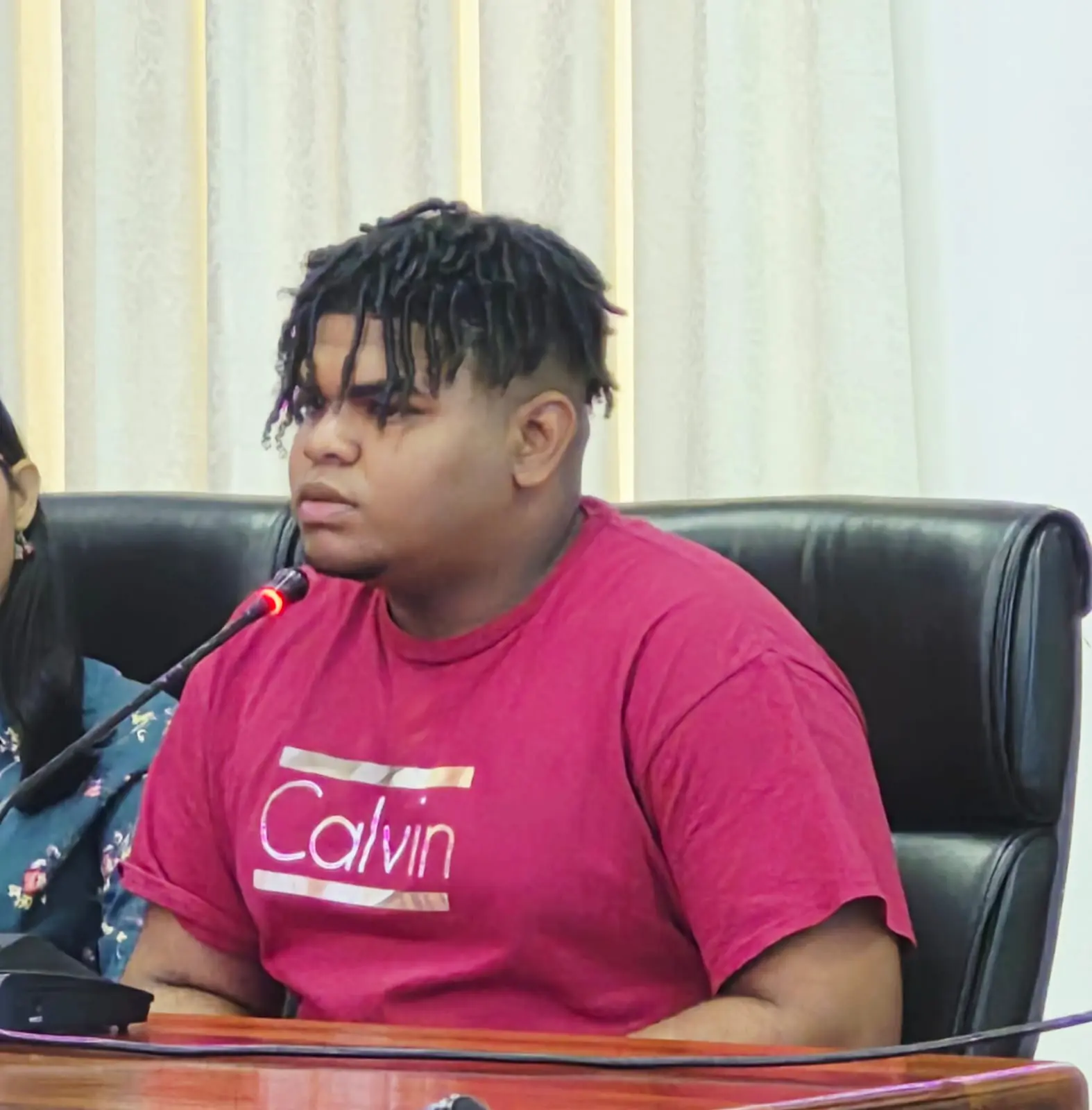
A survivor of the MV Barima tragedy told the Commission of Inquiry (CoI) yesterday that he suspected the vessel was overloaded even before it departed Georgetown, after observing that it was sitting unusually low in the water and hearing passengers complain about the amount of cargo being loaded.
Luis Castillo, who was travelling to Port Kaituma with his aunt, cousin and 17-year-old girlfriend, testified that he noticed the vessel’s condition as it moved away from the wharf and manoeuvred alongside another vessel before departing on July 18. His girlfriend and 16-year-old cousin did not survive the tragedy.
As he responded to questions from Commissioner Nyree Dawn Alphonso, Castillo explained that he noticed the black marking along the lower section of the vessel was no longer visible, with the white-painted portion instead appearing above the waterline. Although he acknowledged that he had no technical knowledge of vessels, he said the MV Barima appeared to be carrying too much weight.
He also recalled hearing a woman complain that the vessel was being overloaded, saying that those responsible continued loading goods despite the concerns being raised.
Castillo told the commission that he initially dismissed the possibility of an accident because he had never heard of such an incident happening before and assumed that the vessel’s condition was normal.
He said he had observed the loading process while waiting at the wharf from approximately 10:00 hrs, recalling that cargo was being loaded until midday, when operations briefly stopped before resuming around 13:00 hrs.
Castillo told Commissioner Dr Andrzej Jasionowski that he had travelled aboard the same MV Barima from Port Kaituma to Georgetown approximately two weeks earlier and had experienced engine problems during that journey, explaining that the engine would initially operate normally before gradually slowing down, almost as though it was about to shut off, before picking up again.
Asked whether the vessel had stopped for repairs, Castillo said it had not and continued its journey to Georgetown despite the problem. He also recalled hearing the engine slow down and apparently cut off again at approximately 21:00 hrs on July 18. He said the engine was subsequently restarted and resumed operating normally, but the incident kept him awake.
Castillo further described the conditions aboard the vessel, telling the commission that there were so many passengers that there was insufficient seating, with some people standing while others placed sheets on the floor to lie down.
He and his family members occupied two hammocks in the second section of the vessel, near the stairs leading to the navigation deck. At approximately 22:00 hrs, he recalled the vessel first tilted towards its left side, causing passengers to scream. It then appeared to stabilise before moving towards the opposite side.
Castillo said he was still in his hammock when water began entering the vessel, eventually submerging him and his girlfriend. He recalled attempting to swim towards the surface with her but eventually became too weak to continue.
He told the commission that although life jackets were aboard, he did not get an opportunity to retrieve one before going under. He eventually regained consciousness at the surface of the water, where he managed to hold onto a bag containing boots.
He later encountered a woman calling for help and swam with her towards a blinking red light in the distance. He estimated that he saw Coast Guard vessels at approximately 04:40 hrs but said he was not rescued until shortly after sunrise.
During his testimony, Castillo also disclosed that his cousin had photographed water at the bottom of the vessel before it capsized. That cousin had gone downstairs to purchase medication to help with vomiting when he noticed the water. He borrowed Castillo’s phone to take a photograph and subsequently showed him the image.
Castillo said the photograph was saved to his iCloud account, although he lost the phone during the incident.
Asked by the commission what he wanted it to remember from his experience, Castillo said those responsible should ensure that vessels are properly prepared before undertaking journeys.
He noted that the MV Barima was not ready to travel with the amount of cargo and the number of passengers aboard, adding that those responsible knew of its condition but allowed it to travel. He described what happened as “negligence.”
Commissioners Jasionowski and Alphonso both commended Castillo for his bravery, with Jasionowski particularly highlighting his decision to turn back towards cries for help while attempting to swim towards the red light he believed could lead to rescue.







Discussion