
Minister of Parliamentary Affairs and Governance, Gail Teixeira on Friday defended the consultation process behind the Sexual Offences (Amendment) Bill 2026 but questions remain about why the government made a sudden decision to press for a public sex offender registry when the bill catered for a closed one.
Teixeira in a statement said that the proposed legislation was subjected to extensive stakeholder engagement over a one-year period and that participants supported the establishment of a closed sex offenders registry.
In the statement amid a continuing controversy over the bill, Teixeira said consultations on the proposed amendments were conducted between 2024 and 2025 under the Support for the Criminal Justice System Programme, an initiative implemented by the Ministry of Legal Affairs with support from the Inter-American Development Bank (IDB).
The minister’s statement came days after Vice-President Bharrat Jagdeo announced that President Irfaan Ali had instructed that the Bill tabled be sent to a parliamentary select committee for further consideration.
The statement did not answer the question as to why the Bill was taken to the National Assembly with the controversial clause. The government has not usually allowed public consultations to guide legislation.
The directive by the President came exactly five days after the Bill was tabled by Minister of Human Services andSocial Security, Vindhya Persaud who had subsequently defended it as progressive, arguing that a registry that was not publicly accessible was consistent with international practice.
However, shortly after Jagdeo’s announcement, the Minister stated on her Facebook page that she and the Cabinet support a public registry and that she had intended to propose that the Bill be sent to a Select Committee.
“The President, myself and the members of Cabinet hold the view that this should be an open register. However, the Bill was crafted based on the views expressed during public consultations, which overwhelmingly suggested a closed register. My intention as subject Minister is to propose that the Bill be taken to a Select Committee in Parliament to allow for further discussion by members. It will benefit from more scrutiny and additional views at that Committee.”
Historic milestone
No such suggestion, however, was made in a statement issued by her ministry just a day earlier. In that statement, the ministry defended the legislation and described the Bill as a “historic milestone” that would establish Guyana’s first sex offenders registry more than 15 years after the passage of the principal Sexual Offences Act.
In response to comments on her Facebook page enquiring as to when the consultations were done, Minister Persaud named Dr Kim Kyte-Thomas, now a Justice of Appeal, as having spearheaded the process as a consultant for the Ministry of Legal Affairs.
Minister Teixeira listed the organisations involved in the consultative process, and these included many Government agencies and Government-aligned organisations.
Some of these were the Ministry of Natural Resources, the Guyana Defence Force, a number of Regional Democratic Councils (RDC), the Ministry of Education, the National Toshaos Council, the office of the Director of Public Prosecutions (DPP), the Guyana Police Force and the Ministry of Labour. Also present were the Guyana Rainbow Foundation, the Medical Council of Guyana, the Women & Gender Equality Commission, the Guyana Rastafarian Council and the Guyana Bar Association among others. July 3rd, 2024 was listed as the date for the consultations.
Consultation process
Teixeira in her statement said a consultant was hired to review the Sexual Offences Act, identify legislative gaps, conduct consultations and make recommendations for reform.
She said the consultation process began with technical discussions involving officials from the Director of Public Prosecutions’ Chambers, members of the criminal bar, magistrates and other criminal justice stakeholders. Government ministries and agencies whose work intersect with child protection, victim support and the administration of justice were also invited to review the proposed amendments and provide recommendations.
Teixeira said that after an initial draft bill was prepared, it was made publicly available and comments were invited from the opposition and the wider public.
She noted that then Attorney General Nandlall publicly invited the parliamentary opposition and members of the public in May 2024 to submit comments on the proposed legislation but said there was no response from the opposition.
According to the minister, comments were subsequently received from a number of organisations and individuals, including Red Thread, the Indigenous Delegation Against Domestic and Sexual Violence, Danuta Radzik, Vanda Radzik and Vidyaratha Kissoon.
Some of those persons had issued a statement confirming that they had submitted recommendations to be included in the Bill and that they welcomed the tabling of the amendments.
On the controversial sexual offenders registry, the group had said that they welcomed the introduction of Section IXA establishing a National Sex Offenders Database. However, according to the statement issued they recommended further consultation on its design and implementation.
“Consideration should be given to establishing both a restricted database and a public sex offender registry, as exists in Trinidad and Tobago. Given past challenges with data collection and database management, adequate time, technical expertise, and clear procedures must be put in place. We are also concerned that prolonged appeals could delay the inclusion of convicted offenders in the database, potentially undermining its purpose,” the group had said.
They also encouraged the public to engage actively with the Government on these proposed amendments.
Circulated
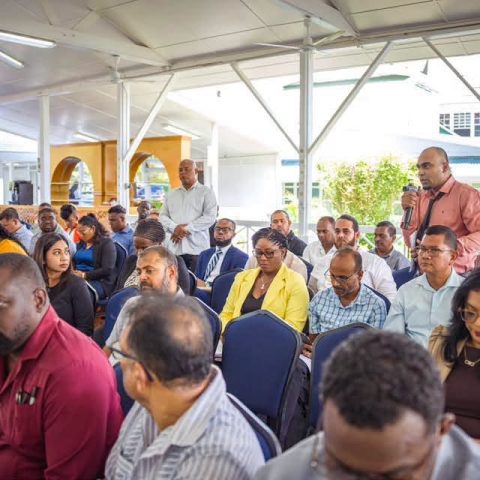
Teixeira said the Guyana Bar Association also circulated the draft legislation among its membership and invited feedback ahead of the national stakeholders forum convened on July 3, 2024.
She said 103 organisations and agencies were invited to participate in the forum and 62 confirmed attendance.
Among the issues discussed was the creation of a national sex offenders registry.
“At the said consultation, some very important amendments were proposed. The establishment of the Sex Offenders Registry/Data Base was welcomed by all participants as a major step forward in monitoring and tracking convicted offenders,” Teixeira stated.
She added that while the issue of whether the registry should be open to the public was debated, the recommendation emerging from the consultation was that it should remain closed, with provision for applications to obtain information on offenders.
The minister said further revisions were made to the draft legislation following the consultation process and that the amended bill was subsequently reviewed by technical stakeholders, including police officers, prison and probation officers, state counsel and police prosecutors, during a sensitisation forum in November 2024.
She also said that the Ministry of Human Services and Social Security held a public awareness symposium at the Umana Yana in April 2025, during which participants were invited to provide feedback on the proposed amendments, including provisions relating to a national sex offender database.
Teixeira rejected suggestions that the legislation had not been properly scrutinised, arguing that the consultation process involved government agencies, civil society groups, professional bodies, technical experts and members of the public over the course of a year.
“It would be grossly incorrect to state that this bill was not subjected to the rigour of consultation and participation of the widest possible views,” she said.
According to Teixeira, the bill subsequently underwent review by the Cabinet Sub-Committee on Bills and Cabinet before being placed on hold because of the proximity of the 2025 General and Regional Elections and the dissolution of Parliament.
Distrust
In an invited comment to Kiskadee Watch, Karen de Souza of Red Thread said the recall of the bill presents an opportunity for more meaningful consultation on the proposed amendments, particularly the provisions establishing the sexual offenders registry. She pointed out that there is widespread public distrust of institutions responsible for collecting and managing data and questioned whether there is sufficient institutional capacity to maintain either a public or non-public registry. While noting that a public registry could expose offenders to vigilante action, she argued that a non-public registry would place significant authority in the hands of institutions that have not demonstrated the capacity to earn that level of trust and responsibility.
Meantime, de Souza also contended that consultations on the amendments had been inadequate, saying stakeholders should be given time to fully consider the implications of the proposed changes. She further expressed concern that insufficient attention has been paid to the prevention measures already contained in the Sexual Offences Act, including provisions for an inter-agency task force and a national plan to address sexual violence, measures which she said have never been seriously implemented by successive governments.
The women’s right activist with years of experience fighting sexual violence repeatedly questioned whether state institutions have the capacity and public trust necessary to manage a sexual offenders registry.
Beyond the registry provisions, de Souza questioned the adequacy of the consultation process, saying some stakeholders felt they were presented with conclusions rather than genuinely consulted. She also expressed concern that amendments dealing with “recent complaint” could revive outdated assumptions that delayed reporting undermines allegations of sexual assault and said other provisions, including those dealing with the publication of an accused person’s identity, lacked clarity. de Souza further lamented the failure of successive governments to implement the prevention measures already contained in the Sexual Offences Act, including the establishment of an inter-agency task force and a national plan to address sexual violence.











Discussion