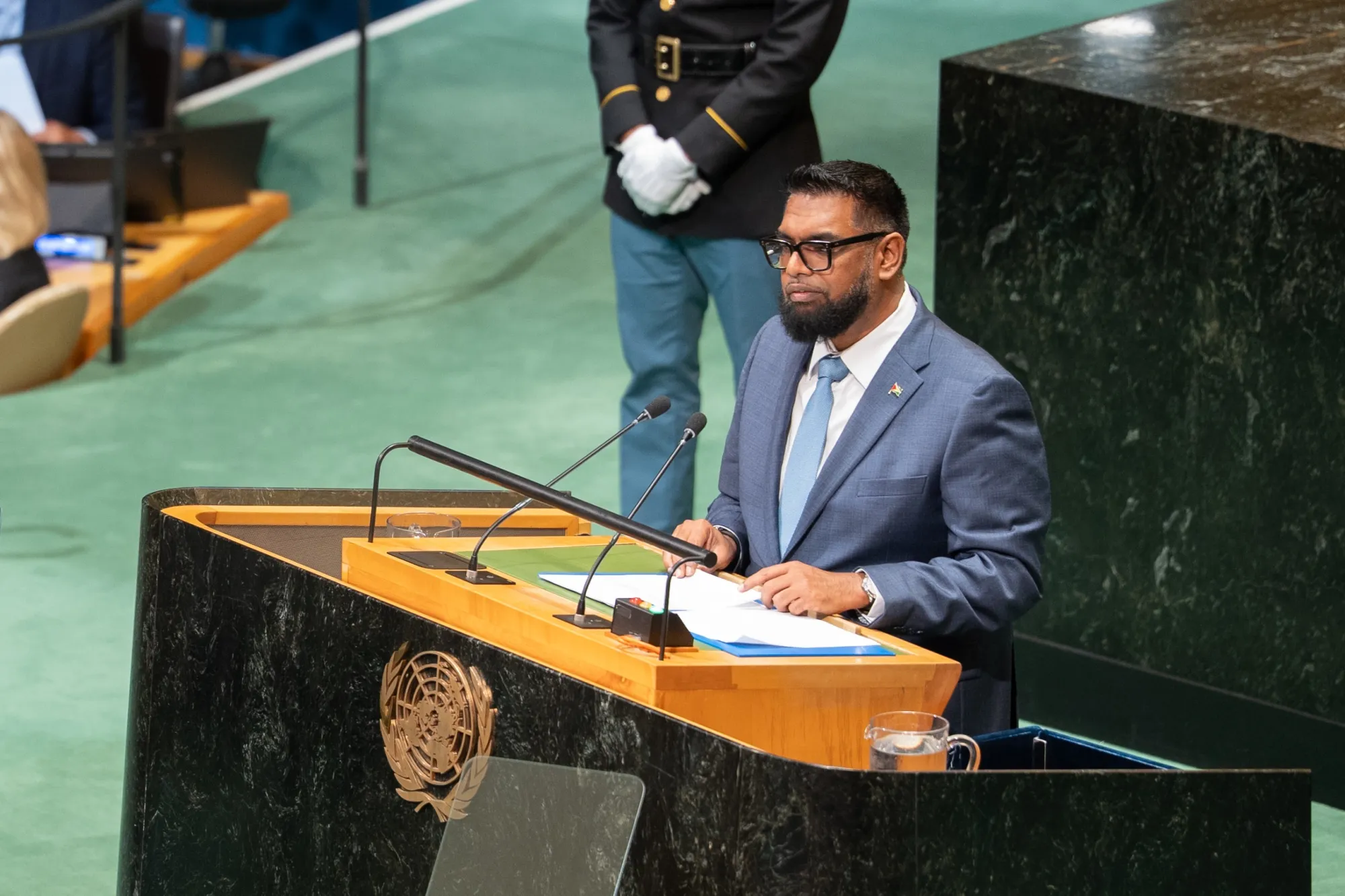
President Irfaan Ali on Thursday called for permanent representation for Africa and for Latin America and the Caribbean on a reformed UN Security Council, saying the body should reflect present-day realities rather than the balance of power in 1945.
In an address to the 81st session of the UN General Assembly, Ali said the organisation faced profound challenges while countries grappled with wars, climate change, food insecurity, debt, rising living costs and widening inequality.
“We need a Security Council that reflects the geopolitical realities of the twenty-first century, not the power structures of 1945,” he said.
Ali called for a UN that was more transparent, accountable and responsive. The General Assembly should carry greater weight, he said, while UN bodies needed to work more coherently, overcoming institutional rivalries and competing mandates. The organisation should also have resources equal to the responsibilities its members had given it.
“The United Nations must not be a monument to the past; it must become an instrument for the future,” he told delegates.
He praised outgoing Secretary-General António Guterres for his service and for speaking plainly about global dangers. Ali said the next Secretary-General would need to bring the UN’s agencies and programmes together, rebuild confidence in the organisation and defend its charter without favour. Choosing Guterres’s successor, he said, would also be a choice about the kind of UN that member states wanted to leave to future generations.
A renewed commitment to multilateralism required more than repeating familiar pledges, Ali argued. Cooperation was necessary in an interdependent world, he said, warning against an international order in which rules were applied selectively.
“The world does not need more sophisticated instruments of destruction; it needs a more sophisticated capacity for peace,” he said. Ali called separately for an end to the wars in Ukraine and Sudan.
On Haiti, he said international financial and material support remained critical to restoring stability and prosperity. Any lasting solution, however, had to be “Haitian-led and Haitian-owned”.
The President also urged governments to put the UN Sustainable Development Goals into national development plans, public policy and budgets. This would make the goals part of decisions about spending and development, he said, rather than leaving them as unfulfilled promises.
Ali presented Guyana as following that approach. He cited significant advances in health care, free education, infrastructure, affordable housing, employment opportunities, financing for small and medium-sized enterprises, and the digitisation of public services.
On biodiversity, Ali said the Global Biodiversity Alliance, established under Guyana’s leadership in July 2025, had expanded from 17 to 138 members. Its second conference, planned for October, would begin mobilising resources and partnerships, he said.
He said Guyana would continue pursuing its Low Carbon Development Strategy, which seeks to link forest protection and climate action with economic development.
Ali also reaffirmed Guyana’s participation in the US-led Shield of the Americas. He said Guyana and the initiative’s other members were cooperating against transnational crime through partnerships and intelligence sharing.
“It is our collective responsibility to never allow our region to be overtaken by gangs or criminal networks,” he said.
The President referred to a joint communiqué adopted this week on economic resilience, security and multilateral coordination. Kiskadee Watch reported that the joint statement identified 24 criminal organisations for coordinated action. Ali did not name them or announce specific Guyanese measures in his address.
Turning to technological change, Ali said artificial intelligence, biotechnology and digital communications could improve health, education, agriculture and public services. Their value, he argued, would depend on whether ordinary people shared in the benefits.
“Technology must not become the privilege of the few; it must become the servant of all humanity,” he said.
Ali ended with an appeal for countries to renew cooperation despite the UN’s shortcomings. “We must not abandon multilateralism because it is imperfect,” he said. “We must renew it because humanity still needs it.”








Discussion