
-Head of Special Branch admits operational records destroyed
A US marshal spoke to businessmen Azruddin Mohamed and his father Nazar Mohamed after they were arrested on October 31st last year pursuant to a US extradition request.
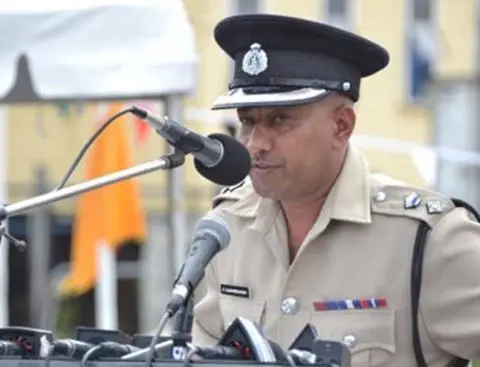
This was disclosed at the Georgetown Magistrate’s Court yesterday by the head of the Special Branch, Senior Superintendent Prem Narine.
He also acknowledged in court that an operational record containing details of his activities on the day the Mohameds were arrested was shredded and burnt months later.
He was testifying as the extradition proceedings against the businessmen continued before Chief Magistrate Judy Latchman.
The disclosures came during cross-examination by attorney Siand Dhurjon, who questioned Narine about records relating to the October 31, 2025 arrests.
Narine confirmed that he had made Station Diary Entry 13 concerning the events of October 31 and identified the entry by his signature when it was shown to him in court.
He further confirmed that he had made no other station diary entry concerning the Mohameds, but acknowledged that an operational record existed detailing what he did that day in relation to the defendants.
Reading from the entry in court, Narine said it recorded the arrest and bringing to the police station of Azruddin Mohamed, described as a 38-year-old Guyanese businessman of East Indian descent, and Nazar Mohamed.
The entry stated that the men were arrested on suspicion of committing money laundering in violation of United States laws, pursuant to an arrest warrant issued by Magistrate Judy Latchman on October 31, 2025.
According to the entry, neither man made an allegation against the arresting ranks and no marks of violence were observed on their exposed bodies.
Narine said the two men subsequently refused to sign the entry, after which he affixed his signature.
Dhurjon then questioned Narine about whether any entry recorded that the defendants were taken elsewhere by police after the station diary entry was made.
The witness was also questioned about permitting a US Marshal to speak with the defendants.
Narine acknowledged that he permitted the US Marshal to speak to the men, but said he did not know what was discussed because, although the defendants remained within his view, they were out of his hearing.
Dhurjon pointed out that the interaction between the US Marshal and the defendants was not recorded in Narine’s operational record.
Narine was asked whether he had made any mention of the interaction in another of the books he had previously referred to. He responded that he believed he had, but could not recall which book.
Under further questioning, Narine said the books were disposed of sometime in early January 2026.
He confirmed that he personally shredded and burnt them.
Dhurjon then put to Narine that when he testified about the US Marshal’s interaction with the defendants, his evidence was based on his recollection of what had transpired rather than a written record.
Narine agreed.
The witness said the records were shredded by machine before being burnt.
Dhurjon suggested that the destroyed operational record was the true record of what Narine had done that day because it contained information that was not included in his statement or the police record.
Narine disagreed.
The attorney then put to him that he had shredded and burnt the only true operational record of his activities that day which had existed.
Again, Narine disagreed.
Asked how the records were destroyed, Narine said there was an area within the Special Branch compound where shredded documents were burnt.
He said he placed the shredded documents, along with other documents, in the area and set them on fire, using either a lighter or a match, although he could not recall which.
Narine said he remained there until he was satisfied that the documents had been completely destroyed and rendered useless.
When asked whether this meant the records were reduced to dust, he said that could be said to be the case.
The witness confirmed that the Special Branch compound was located on Barrack Street, but declined to provide further details about its location, saying it was not something he wanted made public.
Narine was then questioned about the authority under which he destroyed the records.
He said that, as a signatory to Guyana’s Official Secrets Act, he destroys anything he considers secret and believes should be destroyed.
When asked whether he had signed a document called the Secrets Act, Narine responded in the affirmative.
However, when Dhurjon questioned whether he was referring to a statute or a private police document authorising the destruction of such records, Narine said he was not sure whether he was permitted to answer and would need to seek advice.
Following the exchange, the court requested that the document Narine referred to as permitting him to burn the records be produced.
The extradition proceedings have been adjourned to September 21, 22, 28 and 29.








Discussion