– defence alleges police threats and inducements; prosecution cites $55m in damage
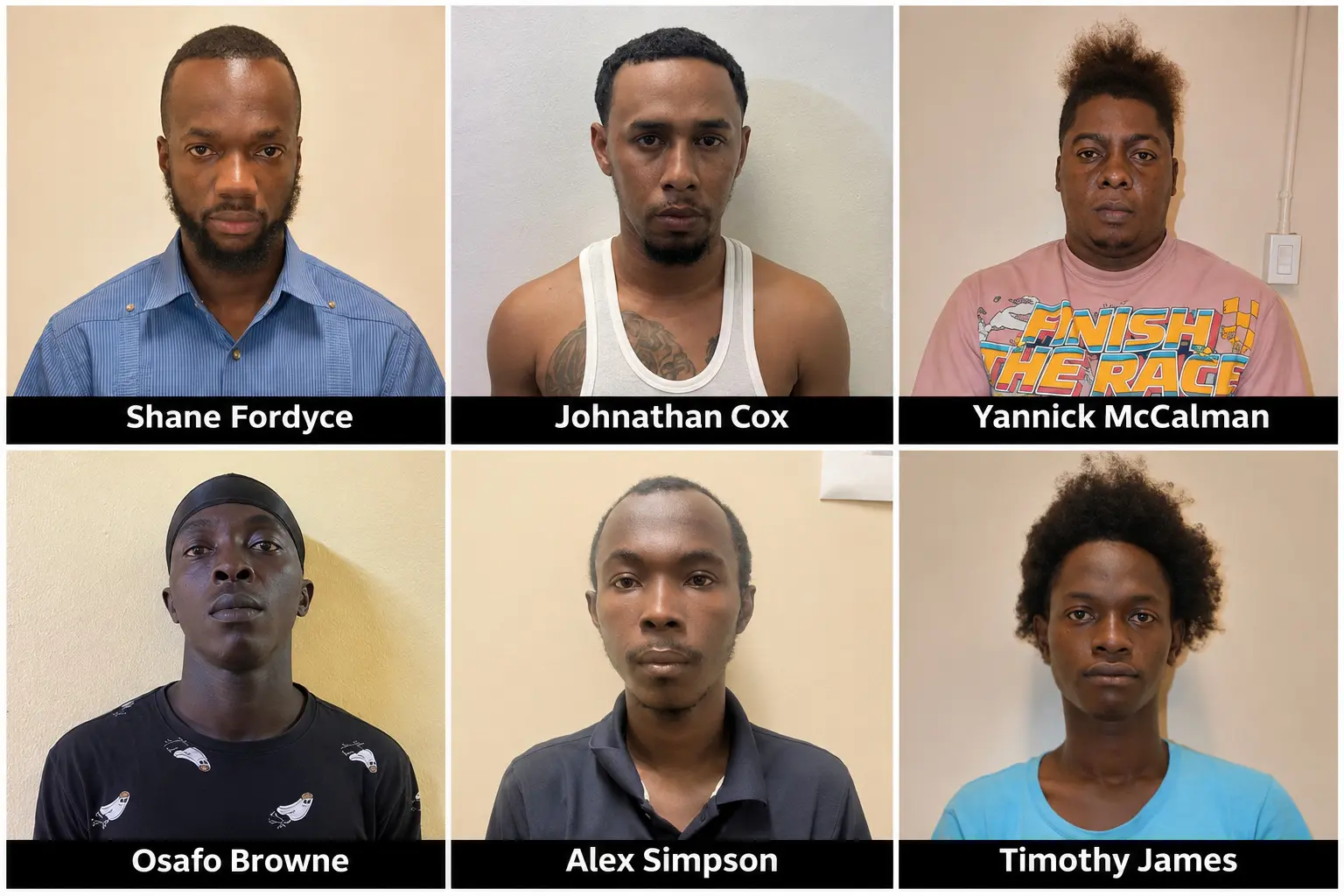
Six men accused of setting fire to the Guyana Power and Light (GPL) substation at Good Hope were yesterday granted bail following a hearing during which defence lawyers alleged that police had threatened and offered inducements to defendants to implicate others.
Magistrate Teriq Mohamed, sitting at the Vigilance Magistrate’s Court, granted bail of $300,000 each to Shane Fordyce, Alex Simpson, Yannick McCalman, Johnathan Cox and Osafo Browne. Timothy James, 18, was granted $99,000 bail after the court considered his age and family circumstances.
The prosecution opposed bail, citing the seriousness of the terrorism charge, the penalty upon conviction and approximately $55 million in alleged damage to the substation. The prosecutor also alleged that defendants had admitted their involvement during video-recorded interviews.
All six must report to Major Crimes Headquarters on the last Friday of each month, either to the diarist or Sergeant Potamu. Fordyce was additionally ordered not to contact witnesses. The matter was adjourned to December 21.
The charge alleges that between November 9 and 10, 2026, at Good Hope, East Coast Demerara, the men used a flammable substance to set fire to the GPL substation with intent to strike terror and threaten Guyana’s security, sovereignty and public safety.
Fordyce is the husband of We Invest in Nationhood (WIN) Member of Parliament Natasha Singh and was also a candidate for the party.
At the hearing, attorney-at-law Ronald J. Daniels, who appeared alongside Eusi Anderson for James, raised concern about what he described as a practice of taking defendants to court at the last minute without informing their families or lawyers.
Applying for bail for Fordyce, Anderson said his client lived at Lot 1110, Flat B, Herstelling, and worked part-time at the Office of the Leader of the Opposition.
He said Fordyce had served in the Guyana Police Force for 12 years, retiring as a corporal in 2024 with an unblemished record. A United States permanent resident, Fordyce had returned to Guyana on June 16, 2026. Anderson also said he had come to Guyana in 2025 to assist WIN with its election campaign.
The attorney maintained that Fordyce understood his obligations to the court, had cooperated with investigators since being taken into custody on November 13, and vehemently denied the allegations.
Anderson questioned the police account that a former policeman whom he described as an “MP in waiting” had conspired with others to commit terrorism.
He said Fordyce had given two video-recorded interviews in which he specifically rejected what Anderson described as counselling by police. Those recordings would be entered into evidence, he said.
Fordyce had also provided investigators with the digital video recorder (DVR) from his home, which the defence maintained would corroborate his movements.
Anderson said his client had participated in a confrontation with McCalman, who allegedly claimed that he visited Fordyce’s home to collect $400,000 to commit the offences and later returned for another $200,000. The attorney maintained that video evidence would disprove that account.
He further alleged that a senior police officer threatened Fordyce with the revocation of his United States green card unless he cooperated with investigators and implicated Opposition Leader Azruddin Mohamed and his father, Nazar Mohamed.
According to Anderson, the officer wanted Fordyce to identify the Mohameds as his bosses and as the persons behind the alleged operation. He alleged that the officer said police knew “a lil black boy like you” could not finance it, and that Fordyce would suffer while others lived comfortably.
The attorney further alleged that the officer told Fordyce his family would be left in turmoil and that being a Muslim labelled a terrorist would be used against him in seeking the revocation of his green card.
Conversely, Anderson alleged, Fordyce was told that if he cooperated, police would ensure that he remained free and received round-the-clock security.
He said Fordyce had asked him not to disclose anything further about the senior officer because of concerns for his safety. His client was nevertheless prepared to undergo a public lie-detector test, Anderson told the court.
Requesting reasonable bail, Anderson referred to bail having been granted in the Quindon Bacchus murder matter at the Sparendaam Magistrate’s Court, arguing that the circumstances were comparable.
Rejected
The prosecutor rejected that comparison. She argued that the allegations before the court concerned conduct extending across two days and an attack on Guyana’s sovereignty.
She cited the importance of the substation in connecting and supplying electricity to Demerara and Berbice, and said further charges relating to alleged attempts against an East Coast school were likely to be brought against the defendants.
The prosecutor also contended that Fordyce initially denied knowing McCalman and acknowledged knowing him only after McCalman disclosed his alleged role.
She said the DVR provided by Fordyce was not functioning and had been returned to him.
Anderson sharply disputed that account, accusing the prosecutor of misleading the court and describing the claim as a “lie from the pits of Hell”.
He challenged her to produce evidence of its return, saying a police record book would contain the recipient’s signature for an item handed back.
The prosecutor responded that Sergeant McKenzie had returned the black DVR and Fordyce had signed for it.
Anderson also challenged the basis of the $55 million damage estimate, saying no supporting documentation had been presented and questioning the prosecutor’s expertise to advance that assessment.
He argued that the Bail Act required substantial grounds to justify refusing bail and maintained that the account of a co-accused could not, by itself, establish Fordyce’s guilt.
The attorney further submitted that the prosecution had not denied his allegations concerning the senior officer. He alleged that investigators had resorted to intimidation and inducements to support the charge, and maintained that his client was being targeted because of his association with the Opposition Leader.
No previous convictions
Applying for bail for James, Daniels said the 18-year-old lived at Lot 10, Friendship, with his mother and siblings and had no previous convictions.
He argued that James was vulnerable because of his age and alleged that police had constructed an elaborate account in which his client was asked to implicate himself, with the allegations ultimately extending to Mohamed.
Daniels also made submissions concerning McCalman, whom he described as 33 years old with no previous convictions.
He alleged that McCalman and his wife had been arrested and that her phone was confiscated. According to Daniels, police threatened to make her life difficult if McCalman did not cooperate.
He said she was required to report to police daily, which he characterised as a tactic to remind McCalman that his wife remained within their reach.
Daniels argued that the circumstances favoured granting both James and McCalman their liberty pending trial.
He also questioned the prosecution’s damage assessment, saying earlier reports indicated that no major damage had been done to the substation, although there had been the potential for substantial damage.
Responding, the prosecutor said police had acted on intelligence and reports in relation to James. She denied that McCalman’s wife had been arrested.
She said the woman operated an MMG business and alleged that the service had been used to transfer money between defendants to facilitate the offence. Both James and McCalman had played active roles, she maintained.
Daniels, drawing on his experience in another case, alleged that the conduct being complained of was not unfamiliar. He referred to the Orlando Douglas murder matter, in which he said he represented an accused, and alleged that police had presented doctored confession statements and a false witness.
Unrepresented
Simpson, who was unrepresented, was invited by Magistrate Mohamed to explain why he should be granted bail.
He said he lived in Diamond and returned home at about 6 pm on Friday, when his mother informed him that police were outside.
According to Simpson, officers told him he was needed at Criminal Investigation Department headquarters. He alleged that he was subsequently told he should work with investigators because they did not want him.
Simpson said police told him they had evidence against him and that three other men downstairs had identified him as a suspect.
He said he denied the allegation and was told that when he went to court he would see himself in a video. Simpson said he was later taken to the Ruimveldt Police Station and then suddenly informed that he had to attend court.
Opposing bail, the prosecutor alleged that Simpson had taken police to the scene and shown them where he obtained the fuel. She further alleged that he admitted participating in the plot and handed over the clothing he had worn.
Attorney-at-law Mikel Puran, representing Cox, said his client was 29, had no previous convictions and denied knowledge of the alleged offence.
Puran referred to earlier terrorism cases involving bombing allegations in which persons he represented, including Jason Jacobis and Ceon Carmichael, secured bail either at their first appearance before a magistrate or subsequently in the High Court.
He argued that the offence was not automatically non-bailable where no death had occurred, and maintained that Cox was entitled to reasonable bail. The seriousness of a charge alone was insufficient to justify refusing bail, he submitted.
Attorneys-at-law Sasha Roberts and Nickesha Baccus appeared for Browne.
Baccus said her client was a gold miner with no previous convictions and denied knowledge of the alleged offence. She alleged that police promised he would not be charged if he gave a statement.
She said five witnesses could support his account and requested reasonable bail.
The prosecutor maintained that the prosecution’s account differed from that advanced by the defence. She alleged that Cox was the contact person whose involvement led to the proceedings, and said video-recorded interviews contained admissions by defendants about their respective roles.
She also argued that the damage alleged in this case was substantially greater than that involved in the Ruimveldt police outpost matter cited during the hearing.








Discussion