
Last Tuesday, Kiskadee Watch reported that the Public Accounts Committee (PAC) was considering a proposal to combine five of the seven backlogged years in its scrutiny of the public accounts. Two days later, the Committee adopted the proposal, with the Chairperson and one other member abstaining from the vote on the ground that they needed time to consider the proposal. It seems unreasonable for the PAC to proceed to adopt a proposal without all members being given reasonable time to consider it. This action does not augur well for the effective functioning of the Committee. One recalls that sometime in 2012, in the absence of one member, the PAC rushed to ratify the appointment of certain senior officers in the Audit Office, thereby paving the way for the appointment of the current Auditor General. That apart, this combined approach was adopted and implemented on several occasions in the past but without any success in bringing the work of the Committee up to date.
In a previous article, we suggested that PAC consider taking a two-pronged approach in addressing these outstanding accounts: detailed examination by the full nine-member Committee of the latest year – 2025; and the simultaneous examination of the earlier six years – 2019, 2020, 2021, 2022, 2023 and 2024 by a five-member sub-committee. In this way, and with dedicated effort, the work of the Committee can be brought up to date within 12 months, without compromising on the quality and comprehensiveness of the PAC’s examination. We must also note that the 2025 report was presented to the Speaker of the National Assembly on 25 September 2026 but close to six weeks on, it is yet to be laid in the Assembly.
Our suggestion is rooted in the fact that no useful purpose will be served by taking a sequential approach not only because of the passage of time but also by the time the PAC gets around to examine the latest year’s accounts, those accounts would have gone backlogged by several years. Additionally, on eight occasions since the restoration of public accountability in 1992, the Committee combined several years together in an effort to bring its work up to date: 1995-1998, 2000-2001, 2002-2003, 2004-2005, 2007-2008, 2010-2011, 2012-2014 and 2017-2018. That effort, however, failed to achieve its objective.
Compare the above situation with what prevails in other countries embracing the Westminster system of government. The Canadian PAC issued its report in June 2025 on the public accounts for the fiscal year 2024-2025; while the United Kingdom did the same in July 2025 in relation to the Comptroller & Auditor General’s investigation on teacher recruitment for the academic year 2023-2024. In India, Pakistan and New Zealand, the PACs (or equivalent) are very active and produce reports on a regular basis.
Trend in PAC examination and reporting
Table I shows the trend in the PAC’s examination of and reporting on the public accounts covering the period 1992 to 2025:
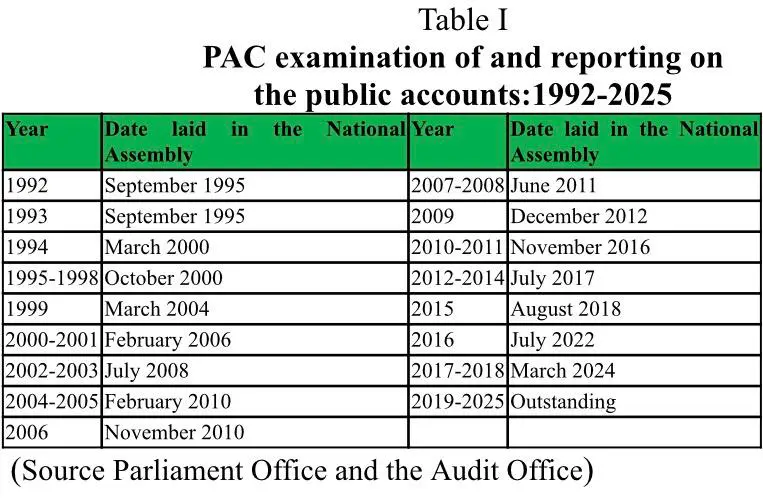
As can be noted, there was a progressive decline in the timeliness of the PAC examination and reporting. While such examinations may be regarded as timely for the years 1992 and 1993, the same cannot be said for subsequent years, as the initial momentum waned. The Committee’s report for 1994 was not laid in the Assembly until March 2000. Additionally, a number of years were examined and reported on together. This declining trend and combined reporting were quite a disappointment, given the earlier struggles, indeed battles, to restore public accountability after a gap of ten years.
The PAC’s examination of and reporting on the 1992 and 1993 accounts was not due to any desire to hold the Government accountable in a timely manner for the use of State resources. Rather, the real intention coming from the Opposition members was to challenge the ‘legality and validity’ of those accounts, since the Opposition party had held the reins of power for the greater part of 1992. In so doing, instead of holding the Accountant General and heads of budget agencies answerable for the deficiencies identified in the Auditor General’s report, these members chose to place the Audit Office on trial for its almost single-handed effort to restore public accountability after a gap of ten years.
In the midst of this onslaught, Government members found themselves helpless to intervene, especially considering the likes of the heavyweights of the late Dr. Kenneth King who was the Chairperson at the time, and Dunstan Barrow now a member of Natural Resource Fund board. Readers are invited to read the 1992 and 1993 PAC reports available at Parliament Office to attest to this. Unfortunately, these two reports all well as those for the years 1994 to 1999 are not available on the Audit Office’s website, although reports issued subsequent to 2004 (the year I demitted office as Auditor General) can be found on the said website.
As regards the examination covering the years 1994 to 1999, the Committee’s work was stymied by the political uncertainty and instability at the time, especially following the death of President Dr. Cheddi Jagan. And so, the rot stepped in from which we are yet to recover.
PAC’s decision to combine five years
The proposal to examine five years of the public accounts covering the period 2020 to 2024 was presented by the Minister of Public Works, who together with the Minister of Governance are members of the PAC. On several occasions, we referred to the undesirability of sitting Ministers to be on the Committee. Since the PAC provides oversight of the Executive, especially as regards the latter’s decisions in the use of public resources, their presence is likely to present a conflict of interest. In the UK, for example, while the Treasury Minister is technically a member of the PAC, he/she does not attend meetings or hearings of the Committee, while in Canada the Standing Orders specifically preclude Ministers from being members of the Committee. The same applies to India, Pakistan, South Africa, Australia and New Zealand. Unfortunately, in Guyana, we are yet to see the merit in prohibiting Ministers from becoming members of the PAC
One Opposition member on the PAC argued that the proposal would reduce the resources and time required for accounting officers to attend hearings, while allowing the Committee to address outstanding queries across multiple financial years in a coordinated manner.However, we must emphasise that there are no shortcuts when it comes to public accountability. After all, it is the taxpayers’ funds that are used to finance public expenditure, and therefore it is of utmost importance that every dollar of expenditure is properly accounted for. Any lesser arrangement is less than ideal accountability and is inconsistent with the principles and practices effective public financial management.
For his part, the Public Works Minister stated that the proposal is intended to move the work of the PAC beyond repeated discussions about the backlog and towards a practical plan for resolving it. He noted that the number of outstanding audit queries declined significantly, from approximately 800 in 2019 to about 179 in 2024, making it more feasible to examine several years of reports during the same sitting. On the other hand, the Chairperson raised concerns that an accelerated approach could undermine detailed scrutiny of public accounts.
The pertinent question we must now ask ourselves is: Given that this combined examination and reporting approach was adopted on eight previous occasions without success in terms of bringing the work of PAC up to date, what guarantee is there that we will now find success in doing so? Additionally, what guarantee is there that there will be no superficial examination of the public accounts using this approach?
A third question relates to the Minister’s assertion that the number of queries raised by the Auditor General was reduced by almost five-fold from 2019 to 2024. The Minister has equated queries with recommendations whereas this is not necessarily so, since queries once resolved having regard to explanations given, do not result in findings and hence recommendations. Also, for every finding there can be more than one recommendation. Some of the recommendations are also a reiteration of previously stated recommendations. In fact, the actual number of recommendations made in 2019 was 645, compared with 168 made in 2024. Table II shows the number of recommendations made by the Auditor General for the years 2004 through 2024, that is, during his tenure of office so far:
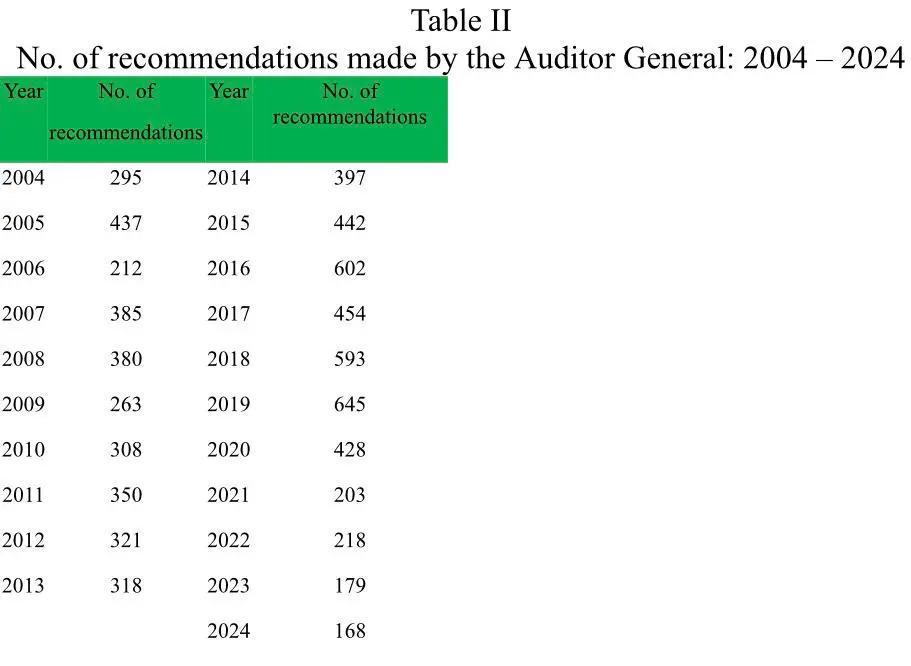
One must note that during the period 2004 to 2014, the average number of recommendations made for each year was 333, compared with 527 during the period 2015 to 2020. From 2021 to 2024, the number has been reduced to 192. The PAC should carefully examine the wide fluctuation in the number of recommendations made covering the three periods.
Some final questions. Was this almost four-fold decrease in the number of recommendations from 2019 to 2024, a reflection of improvement in public financial management and compliance with the relevant laws, regulations and circular instructions? Or was it a reduction in the scope of work undertaken by the Auditor General? One must also not lose sight of the fact it is the PAC that provides oversight of the work of the Audit Office and is required to approve work plans and procedures for the Audit Office as part of its consideration of that office’s annual budgetary allocations. Was this ever done since the constitutional amendment of 2001 and the passing of the Audit Act 2004?
And is the Auditor General adopting the risk-based approach that requires identifying all the associated risks involved in the financial management of the entities audited, the probability of occurrence and the related impact before deciding on the extent of tests to be carried out? Or is he taking a sample of, say ten percent of the expenditure, and writing his report based on the outcome of his examination of this sample? The latter is obviously an inappropriate way of assessing whether expenditure has been incurred: (i) in accordance with the wishes of the legislature; (ii) in compliance with applicable laws, regulations and circular instructions; and (iii) with due regard to economy, efficiency and effectiveness, and the related impacts are commensurate with those intended.
Effects of the change in quorum size
In April 2022, there was a change in the size of the quorum for holding PAC meetings from three (including the Chairperson) to five members – two from the Government’s side and two from the Opposition along with the Chairperson. The Government members on the Committee argued that: (i) the change is necessary to ensure an ‘efficient and accurate scrutinization of the use of public funds’ and to avoid superficial examination being carried out for certain years; (ii) the quorum change offers protection to both sides of the House; and (iii) the 2-2-1 formula provides for greater participation when scrutinizing the audited public accounts and secures representation of both sides. The Opposition, however, vehemently opposed the change, contending that the amendment was an attempt to stymie the work of the PAC and to delay the examination of the public accounts for the years 2020 onwards.
In a previous article, we had stated that the numerous cancellations of the PAC meetings because of the absence of a quorum did not augur well for the effective functioning of the Committee. Indeed, they had the effect of stymying the PAC’s efforts to bring its backlogged examination of the public accounts up to date, and run counter to the principles of good governance, including transparency and accountability in the use of public resources. The continued absence of a quorum also raised serious questions as to the extent of commitment from members of the Committee in relation to their responsibilities. We then posed the question whether these frequent postponements were not a deliberate attempt to delay the work of the Committee in the light of the local government elections that were about to be held at that time; and whether we were going to witness a continuation of this most undesirable state of affairs until the 2025 General and Regional elections are over?
In July 2025, the former Chairperson of the PAC, Mr. Jermaine Figueira, cited the frequent absence of government members from scheduled meetings of the Committee which could not have been held because of a lack of a quorum. He also referred to what he described as bureaucratic resistance, as some agencies were slow, or not forthcoming, in providing necessary documentation or explanations to facilitate the work of the PAC.
During the PAC’s examination of the public accounts for the years 2010-2011, a total of 50 meetings were held, that is, 25 sittings per year. This was under the Chairpersonship of former Minister of Finance Mr. Carl Greenidge. Following the change in Administration in 2015, the current President, then an Opposition member succeeded Mr. Greenidge. The records will show that for the years 2012-2014, the PAC met on only 12 occasions, this is, four meetings per year; while for the 2015 accounts, the number of meetings increased slightly to 13. We had stated while attempts by the Committee to address its backlogged examinations were to be welcomed, our hope was that such an approach did not in any way compromise on the quality and comprehensiveness of its examination.
To be continued







Discussion