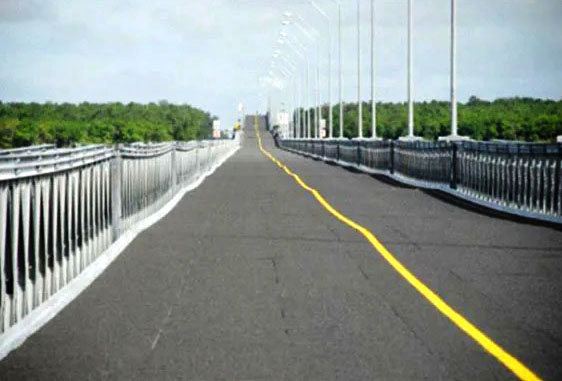
The government paid $400 million to acquire all 400 million issued ordinary shares in the Berbice Bridge Company Inc (BBCI), former company chairman Paul Cheong has confirmed, providing the first detailed account of the transaction since reports emerged that the facility had been acquired by the state.
Cheong, responding to questions from Kiskadee Watch, said the shares were acquired at their nominal value of $1 each following a government policy decision.
“The Government of Guyana paid four hundred million Guyana dollars ($400,000,000) to acquire the 400,000,000 issued ordinary shares of the Berbice Bridge Company Inc at their nominal value of one Guyana dollar ($1.00) per share,” he said.
His response clarifies that the reported $400 million represented payment for BBCI’s ordinary shares rather than a stated valuation or purchase price for the physical bridge and the company’s entire asset base.
According to Cheong, the six shareholders received payments in proportion to their ordinary shareholdings.

The National Insurance Scheme (NIS), Secure International Finance Company Ltd, Queens Atlantic Investments Inc and New GPC Inc, which each held 80 million shares, received $80 million apiece.
Hand-in-Hand Mutual Fire Insurance Company Ltd and the state-owned National Industrial and Commercial Investments Limited (NICIL), which each held 40 million shares, received $40 million apiece. The payments totalled $400 million.
Cheong said the transaction resulted from a policy decision by the government to acquire BBCI’s ordinary shares.
“Following the Government’s decision, all shareholders of the Berbice Bridge Company Inc formally approved the sale of their ordinary shares and subsequently approved the winding-up of the Company through the appropriate corporate processes,” he said.
He declined to provide the Cabinet memorandum and decision authorising the acquisition, saying both documents belonged to Cabinet and were confidential. He suggested that requests for further information about the policy decision be directed to the Secretary to the Cabinet.
Cheong said BBCI’s other outstanding obligations were settled from the company’s own funds in keeping with the applicable requirements. He did not identify those obligations, their total value or the amounts paid to creditors and holders of preference shares, bonds and subordinated debt.
The disclosure answers several of the questions raised after media reports said that the government had acquired the bridge. Neither the government nor BBCI had previously issued a detailed public statement confirming what was purchased, how the sum was calculated or how the proceeds were divided.
It remains unclear whether an independent valuation of BBCI’s shares or assets was conducted before the acquisition and what assets and liabilities the government ultimately assumed by purchasing the company’s ordinary shares.
Surprisingly low
Former Public Works Minister David Patterson had described the reported $400 million price as “surprisingly low” when compared with BBCI’s former financial position and its previous asking price.
“As indicated in our conversation, the sale price was surprisingly low, based on the previous position stated by the BBCI,” Patterson had told Kiskadee Watch before Cheong’s disclosure.
Patterson said that between 2015 and 2020, BBCI had placed an $8 billion price on the acquisition of the bridge.
“It would be of great interest as to why they are willing to sell now at this greatly reduced price, a price—$400 million—which we would have found acceptable,” he said.
Cheong’s response indicates, however, that the $400 million was not presented as the value of the bridge but as the nominal value of all BBCI’s issued ordinary shares. It does not disclose the value assigned to the company’s other securities or explain the overall cost to the state of assuming control.
Patterson had also questioned whether the arrangement involved concessions or commitments beyond the acquisition.
“I do suspect that there is something else in the arrangement,” he said. “Other than just the sale of the bridge, I’m sure there is some sort of other concessional agreement with the Berbice Bridge Company. That’s what we need to find out.”
Cheong did not report any additional concession but said the Cabinet documents underlying the transaction could not be released by BBCI.
Documents supplied by Patterson show that, during an October 2018 meeting with the then APNU+AFC government, BBCI reported debts exceeding $6 billion while seeking steep toll increases.
The company’s proposals would have increased the toll for cars and minibuses from $2,200 to $8,040 and that for pickups, four-wheel-drive vehicles and small trucks from $4,000 to $14,600.
The toll for articulated trucks would have risen from $32,000 to $116,680, while the charge for boats would have increased from $55,000 to $410,040.
The then government rejected the increases and Patterson issued the Berbice River Bridge (Public Safety) Toll Order in November 2018. It allowed the government to exercise the concessionaire’s maintenance and operational functions and kept tolls at their existing levels.
BBCI challenged the order, but acting Chief Justice Roxane George dismissed its application in December 2019. She ruled that the minister had the authority to influence tolls by setting maximum rates and that BBCI could not increase them unilaterally. She also found that the order did not amount to a government takeover of the bridge.
BBCI subsequently said it recovered after 2020 because of increased traffic, cost controls, improved economic activity and a more constructive relationship with the government.
Since August 2025, crossings have been free to users, with the government meeting the tolls for vehicles and vessels.
In a statement announcing its voluntary liquidation, BBCI said the bridge and its employees would enter “a new chapter under public stewardship.”
“The Company will wind up. The Bridge will remain,” it said. “Accounts will be settled. Investors will receive what is due. Employees and the Bridge will move into a new chapter under public stewardship.”
BBCI said that by the time of liquidation, the NIS was projected to receive a total return equivalent to approximately 236% of its original investment. It did not provide a financial breakdown supporting that calculation.
The NIS held $80 million in ordinary shares and was therefore paid $80 million from the share acquisition, according to Cheong’s breakdown. Stabroek News had previously reported that the scheme also held $950 million in BBCI preference shares. Cheong’s response did not state how much the NIS received in relation to those securities or its other investments in the company.
According to notices published in the September 12 edition of the Official Gazette, BBCI’s shareholders passed a special resolution on August 21 to wind up the company voluntarily. Chartered accountant Raan Motilall was appointed liquidator.
The bridge, which cost approximately $8 billion, opened in December 2008 under a public-private partnership. The June 2006 concession agreement provided BBCI with 21 years of exclusive operation.
The government has separately announced plans to build a new four-lane, high-span bridge across the Berbice River. It has not publicly explained how its acquisition of BBCI’s shares relates to the proposed bridge or the approaching end of the existing concession.







Discussion