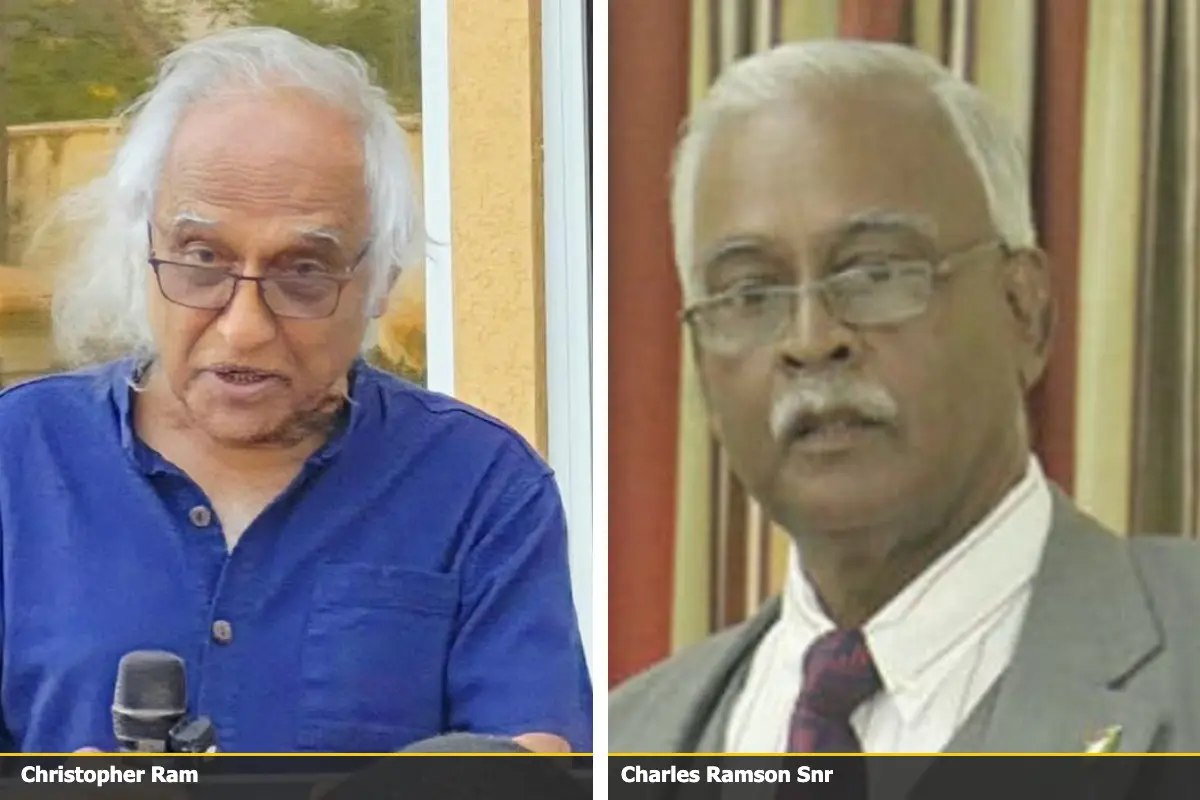
Justice Nicola Pierre yesterday ordered the Commissioner of Information Charles Ramson Snr. to process and determine within 60 days three requests for information by commentator Christopher Ram.
The judge’s ruling following a judicial review application on 19 June 2025 by Ram in relation to the functioning of Ramson’s office will be seen as a major victory for civil society. Ram had led a series of protests for Ramson to comply with requests for information on ExxonMobil’s tax affairs and other areas. Ramson had resisted these requests and Ram then filed a judicial review application.
Justice Pierre ordered that Ramson shall process and determine each of the three requests in accordance with the Access to Information Act 2011, including sections 18 to 26 insofar
as applicable, and in accordance with the interpretation of the Act contained in her judgment.
The determinations shall be made and communicated to Ram within sixty days of yesterday’s order.
If access to any requested document is granted, the Commissioner shall provide access in accordance with the Act. If access is refused, or if the Commissioner determines that a requested document does not exist or cannot, after a thorough and diligent search, be located, the judge said that the Commissioner shall comply with section 23 of the Act and provide the Applicant with the written notice and reasons required by that section, including the Applicant’s right to apply to the High Court for judicial review.
The judge said that the declaration sought by Ram that the Commissioner failed to comply with section 23 by failing to provide reasons for a substantive refusal is refused, there being no
evidence of an actual substantive refusal decision to which section 23 applied at the relevant time.
Ram also won costs which are to be assessed.
In her ruling Justice Pierre found a lack of candour on the part of Ramson on the question as to whether he had received the requests for information from Ram and said that this was “particularly ironic and lamentable in proceedings concerning the Access to Information Act and the Commissioner of Information”.
Another of Ram’s requests had related to the statutory annual report that Ramson was supposed to submit to Parliament listing the various requests received for information among other things. Such reports have never been submitted to Parliament by the long-serving Commissioner of Information.
Adverting to casuistry in one of Ramson’s rejoinders, the judge said that the section 44 annual report is not a document which Ram has asked the Commissioner to create or to compile for the purposes of answering the request.
“It is a document which the statute itself requires the Minister to prepare and lay before the National Assembly. Its subject matter is the operation of the very Act under which the request for access
is made. The Act itself prescribes that the report is to contain information concerning requests made to the Commissioner and other matters concerning the administration of the statutory
access regime.
“The March 12 request therefore was not, as the Commissioner characterized it in his letter of 24 March 2025, an ‘absurdity’ by which the Commissioner was being asked to ‘self-oversee!’
“Nor was it an attempt to place the Commissioner in the position of determining the propriety of his own conduct. That is not the Commissioner’s role under the Act in any event, his is not
the power to ‘oversee’ public authorities but to be ‘a clearing house for processing requests’ for information made under the Act [s.5(2)]”, the judge said.
The judge said that the request sought existing records and information concerning the operation of a statutory scheme, information which the Act specifies must be collected, compiled and given to the Minister and must be included in reports which the Act itself requires to be prepared and laid before the National Assembly.
Ramson’s argument in court was that his office fell outside of the definition of a “public authority”. Justice Pierre disagreed.
She said that she did “not accept the respondent’s argument that the Commissioner falls outside the definition of “public authority”. In my view the Commissioner of Information falls within the
statutory conception of a public authority. The office exercises statutory functions on behalf of the State, is financially and administratively supported through Government, and operates
within a statutory reporting structure for which the Minister bears responsibility to the National Assembly.
“I find that the Commissioner of Information is a public authority within the meaning of section 2 of the Access to Information Act 2011”.
The judge also disagreed with Ramson’s argument that the Access to Information Act required Ram, as a precondition to invoking
the statutory process, to first apply to the public authority believed to hold the information and obtain a refusal.
“I find no such requirement in the Act. The Commissioner mandated that the applicant prove he had applied for the information at its source, and referred to section 15 as
imposing that requirement. The commissioner clearly misunderstood the statutory scheme”, the judge found.
Ram last night welcomed the judge’s ruling.
“I welcome Justice Pierre’s ruling, which I believe is the first court test of the Access to Information Act since it was passed in 2011.
Because of the conduct of the Office of the Commissioner of Information, many Guyanese had come to believe that the office was beyond reach. The Court has now made clear that the Commissioner is a public authority, bound by the Act and answerable to the courts. He cannot send applicants away to ask the very ministries that hold the information.
This matter concerns disclosure of the taxes paid by the Government of Guyana on behalf of ExxonMobil and its partners, matters of the highest public interest. The Commissioner must now decide my requests within sixty days and, if he refuses, give his reasons in writing, which I can challenge.
“Whatever the Commissioner’s earlier conduct and reservations, I hope he will now perform his statutory functions and help create the space for information on public affairs to flow freely. Democracy depends on it”, he said.
He thanked his attorneys Khemraj Ramjattan and Andriska Thorington for their representation.
Ramson, a former attorney general, was represented by attorney Pauline Chase.
For years, a number of persons have complained about the flippant and dismissive attitude of Ramson to requests for information. There had been an attempt to remove him during the APNU+AFC administration but this failed and he was restored to his position in 2020 by the PPP/C government. The government has not sought to hold him accountable for his annual reports and in this year’s budget voted funds again for him without addressing why he was not complying with the requirements of the Act.













Discussion