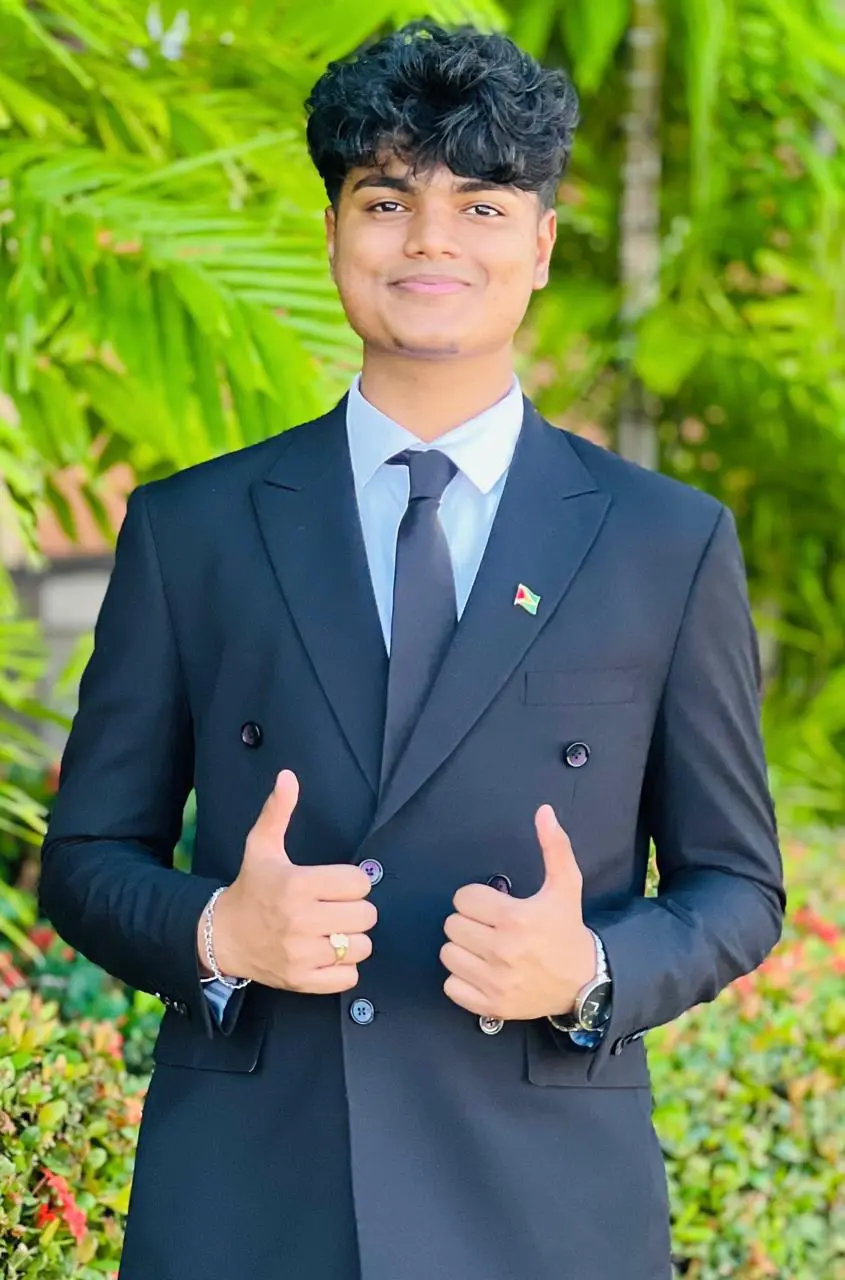
Financial constraints prevented Naresh Jagnanan from taking up a place at one of Georgetown’s leading secondary schools. Years later, the former Essequibo Islands Secondary School student has graduated from the University of the West Indies (UWI), St Augustine, with first-class honours and as a valedictorian of its Faculty of Social Sciences.
For the 21-year-old from Belle Plaine, Wakenaam, the journey is one he attributes to “divine intervention”.
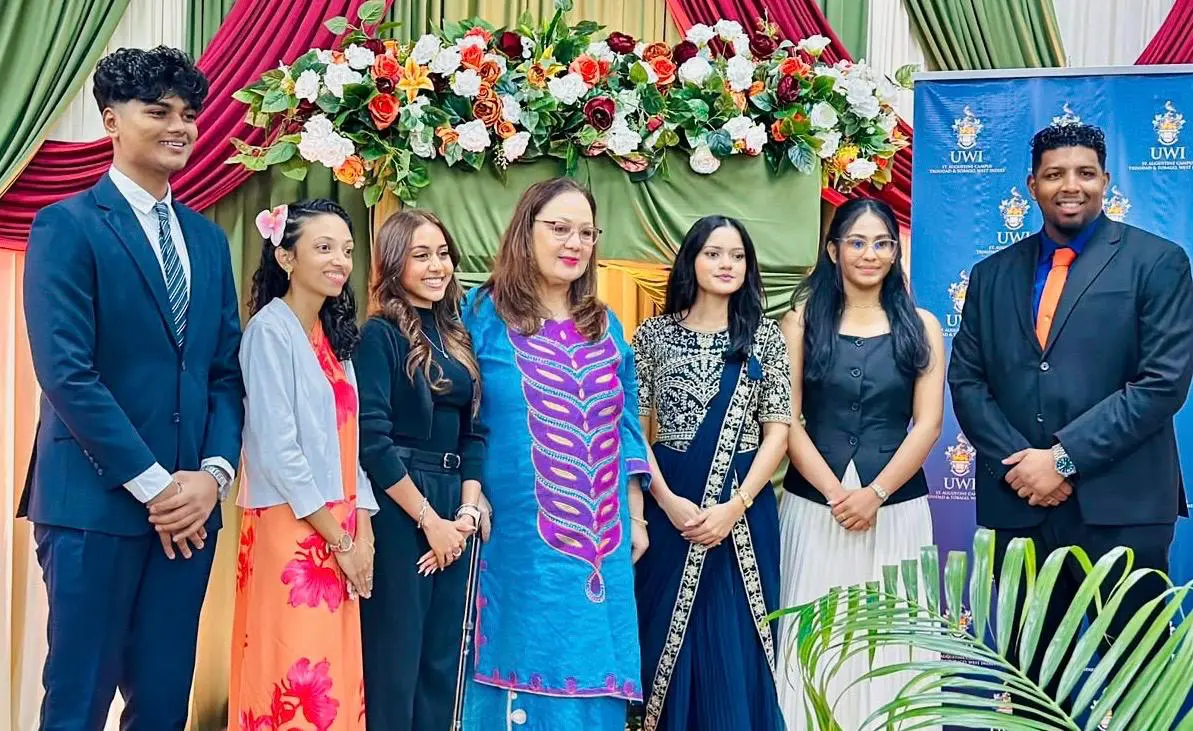
Jagnanan earned a bachelor’s degree in economics and political science. He said he was nominated for valedictorian by the departments of economics and political science and the Guild of Students, in recognition of both his academic performance and his contribution to student life.
Reflecting on his upbringing in the farming community and the opportunities that followed, he told Kiskadee Watch that the experience was difficult to describe.
“What are the chances of a student from a C grade school with parents from a struggling humble background being chosen from among thousands of Caribbean students, to be honoured by the university? 0.001 per cent probably. It has to be God’s divine intervention. That’s the only way I see it,” he said.
Jagnanan attended San Souci Primary School and topped Wakenaam at the National Grade Six Assessment, earning a place at a leading Georgetown secondary school. His parents, however, could not afford to send their then 11-year-old son to the city, where he had no family member with whom to stay.
He instead attended Essequibo Islands Secondary School in San Souci. As the island’s top NGSA pupil, he received a bicycle, which he used to travel to school.
“The majority of students rode bicycles to school. In the mornings we ganged up and rode to school and in the afternoons, we returned home together.”
He went on to secure Grade One passes in all 11 subjects he wrote at the Caribbean Secondary Education Certificate (CSEC) examinations, a first for the school. The Caribbean Examinations Council (CXC) also named him the region’s most outstanding CSEC student in business studies that year.
“It was the first time in its 58 years of existence that a student of EISC got that award,” he said.
His performance earned him a CXC/UWI scholarship covering tuition, accommodation and a stipend at a UWI campus of his choice. He had to qualify for admission through the Caribbean Advanced Proficiency Examination (CAPE) and take up the scholarship within three years.
By the time the scholarship was announced in February 2022, admissions deadlines at schools offering CAPE had passed. Jagnanan said he gained entry to Queen’s College through the intervention of then Education Minister Priya Manickchand.
“So, from February I prepared to write five Unit 1 subjects for my first year of CAPE. I had very limited time to prepare for the exams. The exams were written in May 2022.”
At 16, he also had to adjust to life in Georgetown, where he stayed with a relative. He secured Grade One passes in all five units.
“I even made the merit lists,” he said, laughing.
With only a few months to prepare, he knew he could not afford to lose focus.
“There was no way I could have slacked off. It was rigorous but it taught me a lot of time management skills.”
Encouraged by those results, he took on ten units in his second year, earning nine Grade Ones and a Grade Two. He was named Guyana’s top CAPE student in August 2023, having completed 15 units over the two years.
At its 2023 awards ceremony, CXC recognised him as the Caribbean’s most outstanding CAPE student and its most outstanding CAPE student in business studies. He also received an ACCA award, while Queen’s College received the School of the Year Award for its CAPE performance.
Jagnanan said he was subsequently awarded a Presidential Scholarship. By the time it was announced, however, he was writing his first-year final examinations at UWI and chose to remain there.
“I had already made friends, and I was settled into university life, and boy I did not regret that decision to stay at UWI for a single moment,” he said.
In his valedictory address, he urged students not to allow their backgrounds or financial circumstances to limit their ambitions.
“There is no greater betrayal to yourself than abandoning your own becoming,” he said.
His parents’ experiences helped shape that determination. His father is a potter who also works as a security guard, while his mother is a domestic worker. Neither completed secondary school. Jagnanan said they had been taken out of school to help with farming or household work, a practice he described as common in Wakenaam at the time.
“My mom really pushed us. She said she did not want her children to experience the same life she had,” he said.
He recalled his mother mopping and cleaning to support the family, and her wish that her children would not face the same struggle to make ends meet.
His two sisters now teach at Essequibo Islands Secondary School. His older sister, he said, faced the greatest difficulties during her school years.
“We studied late into the night with kerosene lamps. Kerosene lamps were mainly used in Wakenaam at the time because we had no electricity. We finished homework some nights using candles and even torchlights.”
He benefited from textbooks passed down by his siblings and was able to read them before reaching the classes for which they were intended. With electricity now available, he believes children on the island have an easier time studying.
University life
At UWI, Jagnanan lived at Canada Hall, sharing accommodation with students from across the Caribbean. He said he concentrated on academics in his first year and made the Dean’s List every semester throughout his studies.
“We lived in a shared space that we called home. We got to know about community,” he said.
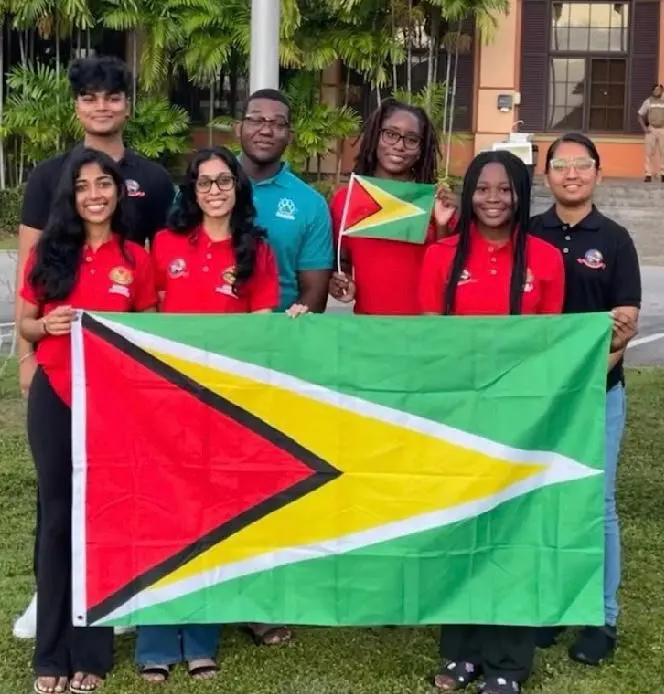
In his second year, he became vice-president of the Guyana Students’ Association of Trinidad and Tobago (GUYSATT). He helped organise activities involving Guyanese students at UWI and other institutions, including the Hugh Wooding Law School, the University of Trinidad and Tobago and the University of the Southern Caribbean.
The association held cultural events, pop-ups, Amerindian Heritage Month activities and a Guyana Culture Night, both on and off campus.
“We really showcased our ‘Little Guyana’ in Trinidad,” he said.
Working with other national student associations also strengthened his interest in Caribbean cooperation.
“If we can bring together associations like this in one space, what can we not do as a region?” he asked.
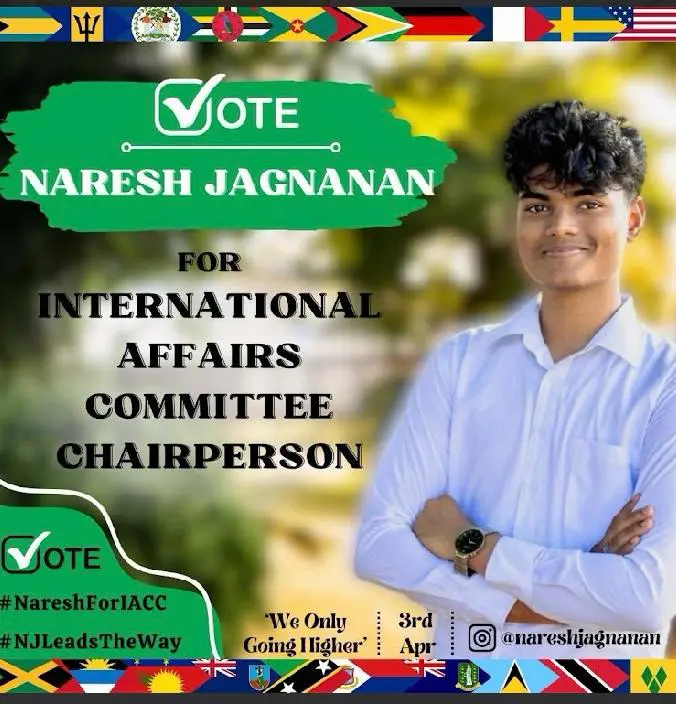
In his third and final year, he contested the chairmanship of the Guild of Students’ International Affairs Committee (IAC). He said he received the highest number of votes across the guild’s committees.
“That moment was a reminder that I was there for service. I was there because people believed in me and I was there because I believed that change must happen. That was the pivot that really shaped my thinking.”
The role involved representing about 1,500 regional and international students and ensuring their concerns were heard by the university administration.
Under his chairmanship, the committee organised a Caribbean Integration Season, bringing together the various national student associations. Among its activities was the transformation of the JFK Quadrangle into an airport-inspired cultural hub featuring food, storytelling, drumming, dancing and singing.
“It wasn’t just Trini or Guyanese cultures. It was the bringing together of different accents, different histories and traditions like jab jab, masquerades.”
He also led the IAC’s Hurricane Melissa relief drive, which he described as the largest organised at the St Augustine campus.
When the hurricane struck Jamaica in late October, he said, Jamaican students were preparing for examinations while worrying about their families and whether financial support from home would continue. Tuition deadlines and daily living expenses added to their concerns.
“We had to step in. I mobilised campus and university officials early and I got them to create a plan before the hurricane evolved to category five,” he said.
The response included an extension of the tuition payment deadline and university bursaries for some affected students. The committee also approached sponsors in Trinidad for assistance with food and other necessities.
Jagnanan said more than 1,000 students became involved in the three-week relief drive. The campus has 90 clubs, and he recalled participation from clubs he had not previously known about, alongside representatives of nine university departments and two Trinidadian non-governmental organisations.
The university donated 100 cartons of relief supplies for Jamaica and 100 grocery packages for Jamaican students, he said.
“That was when I saw what people can do when we come together. That was a very defining moment in my journey at UWI. It puts into perspective just how much impact we can make if we all come together.”
For his work in 2025/2026, Jagnanan was recognised as the guild’s most outstanding councillor, best team player and most outstanding committee chairperson.
He said student advocacy had changed his own outlook as much as it had helped others.
“I have seen how much advocacy can do especially in rooms with university and campus officials and how much that could literally influence and change people’s lives.”
After his final examinations in May, he returned to Guyana and is now a financial analyst at the Ministry of Finance.
He has applied to universities to pursue a master’s degree in economics and said he had been accepted by all those to which he applied. Among the institutions he is considering are the University of Oxford, the London School of Economics and Political Science, and Imperial College London.
“I’m keeping my fingers crossed that I do get through with a scholarship,” he said.
Asked where he saw himself in ten years, he said: “I’m not sure where and who I will be, but I know that I would be serving people. I am not interested in filling the pockets of corporate business.”
He chose the Ministry of Finance because he believes it can help address prices and protect vulnerable people.
“Regardless of what fancy term I’m given or fancy title I get, my mentality of helping people or serving people will remain in the front of whatever I do.”
He traces that outlook to Wakenaam and the support he received from relatives, teachers, neighbours and small shopkeepers. Teachers helped pay for his CSEC examinations, while others contributed towards his university studies or offered encouragement.
“We may not all be connected by blood, but we are connected by relationships. That is our way of life in Wakenaam.








Discussion