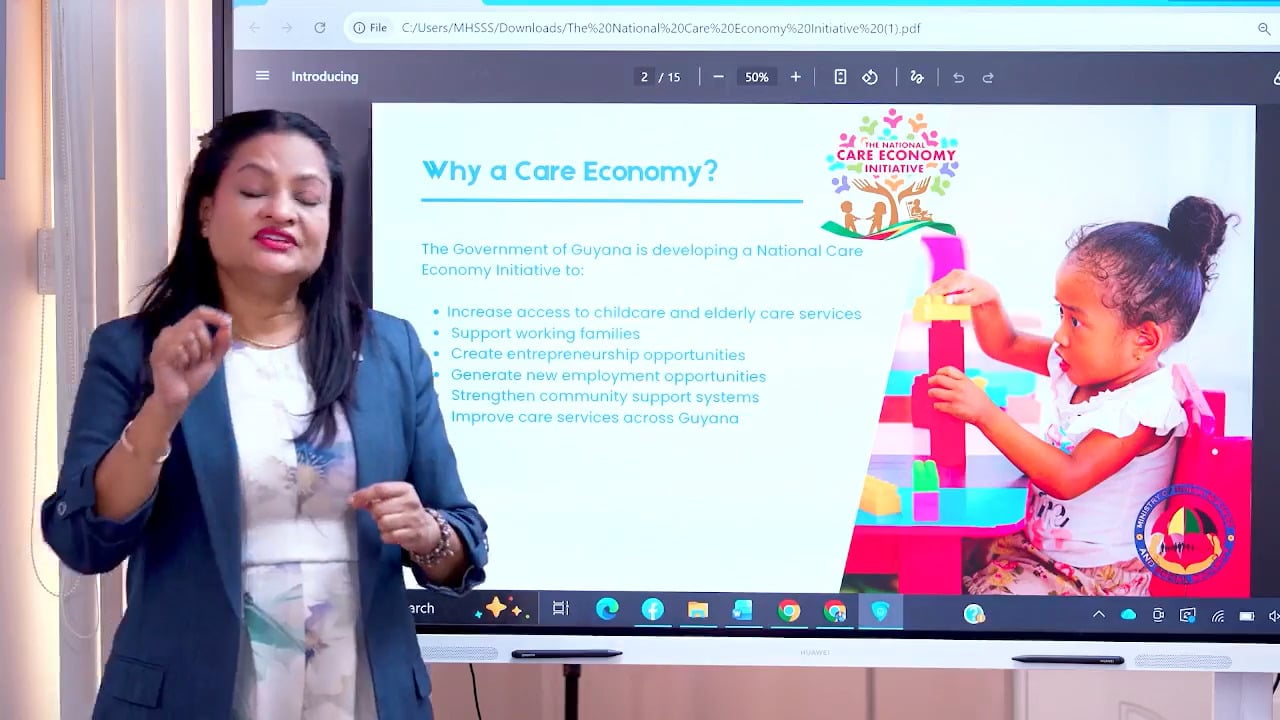
Persons seeking support under the government’s $1.2 billion National Care Economy Co-Invest Initiative must have access to suitable existing premises, Minister of Human Services and Social Security Dr Vindhya Persaud has said, explaining that the programme will fund improvements and equipment but not new buildings or property purchases.
In a video posted on the ministry’s Facebook page, Persaud outlined the requirements for individuals, community groups, religious organisations and businesses interested in providing childcare or non-medical services for elderly persons.
She said the government’s investment would extend over two years and was intended to expand access to affordable care while creating employment and business opportunities.
The assistance would take the form of grants rather than loans, she stated. However, expressing interest would not automatically secure funding.
“Not because you apply, it means you automatically get through,” Persaud said, explaining that officers would assess proposed premises and discuss applicants’ plans before an application package was provided.
Applications would be considered against the programme’s eligibility requirements, the applicant’s readiness and available resources.
The initiative will support home-based and community childcare, facilities operated by employers, and services established by non-governmental and faith-based organisations. Elder care options include community centres, home visits and meal-delivery services.
Persaud encouraged interested persons to form groups, bringing together those with relevant training and a willingness to provide care.
Applicants must have an enclosed space in a safe location and the legal right to use it, whether through ownership or an arrangement with the owner. Suitable premises could include an unused room, a separate building, a community centre, village hall or religious facility.
“We’re not building anything. We are not enclosing an open space. We are not building on an empty land,” the minister said.
Assistance could cover washroom facilities, painting and some doors and windows, but would not extend to substantial construction such as walls or roofing. Furniture, equipment, learning materials, training, certification and registration would also be supported.
Persaud said police clearance was important for caregivers, while both the premises and surrounding environment would be assessed for safety. She cautioned against locating facilities next to alcohol outlets or places where children could be exposed to unsafe behaviour.
Lack of training would not prevent persons from expressing interest, she said, as free childcare and elder care courses were available. Applicants were encouraged to begin training while pursuing their business proposals.
The training would include health and safety, child protection, safeguarding, first aid and entrepreneurship, with online instruction and practical components.
The minister stressed that elderly care under the initiative would be non-medical. Services could include companionship, supervision, assistance with mobility and recreational activities, as well as visits to ensure that seniors were not left unattended.
“This is not about medical care, giving injections and IVs and all of that. This is social support,” she said.
Meal-delivery services could also be developed for seniors, with food suited to their health needs. Childcare operators would not be required under the programme to prepare meals but would need safe arrangements for storing food brought for children.
Persaud also encouraged employers to establish care facilities on their premises or contract providers to serve their employees. She referred to corporation tax relief for companies investing in care.
Stabroek News reported during the February budget debate that Persaud had highlighted the removal of corporate tax for companies offering childcare as part of the government’s care economy programme. She also pointed then to the expansion of the Women’s Innovation and Investment Network (WIIN), which she said had trained 21,000 women.
The programme had attracted approximately 780 individual and group registrations by July, according to a ministry report. At that stage, Persaud said 459 persons were being trained to offer home-based and community care in Regions Two, Three, Four, Five, Six, Seven and Nine. Those figures relate to July rather than the latest video.
During the Facebook presentation, a programme representative acknowledged complaints from persons who had registered but had not received responses. She attributed the delays to the volume of applications and said officers were still processing submissions.
Persons awaiting contact were advised to send their telephone numbers through the ministry’s Facebook Messenger. Those seeking assistance with WIIN training were directed to WhatsApp number 618-0612.











Discussion