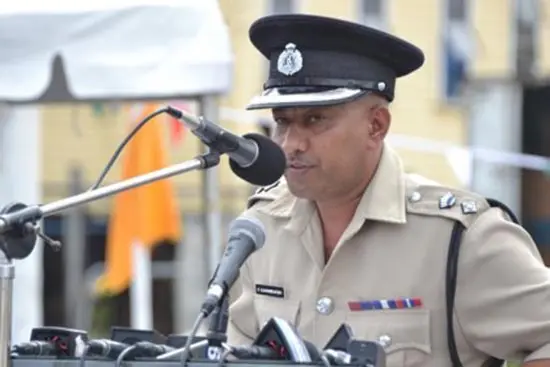
Commissioner of Police Clifton Hicken has withdrawn his October 7 letter granting Deputy Commissioner Fazil Karimbaksh leave prior to retirement, citing further consideration of the constitutional and legal powers governing the office.
The reversal is contained in an October 12 letter to Karimbaksh, Head of the Special Organised Crime Unit (SOCU). In separate correspondence bearing the same date, Karimbaksh’s attorney, Rizwaun Mohamed, protested an alleged instruction barring his client from his office and threatened urgent court proceedings.
The documents raise fresh questions about Karimbaksh’s status after the Guyana Police Force announced on October 8 that he had been sent on leave pending an investigation into allegations of rape and threatening behaviour made by a female police inspector. That announcement did not specify the type of leave, its commencement date or who would perform his duties.
In his latest letter, Hicken wrote: “I hereby rescind and withdraw my previous letter by which leave was granted to you with immediate effect.”
He said the decision followed further consideration of the constitutional and legal framework governing authority over the office of Deputy Commissioner, including the respective powers of the President, the Police Service Commission and the Commissioner of Police.
“Accordingly, the said letter shall cease to have effect, and any further action concerning the grant of leave shall be undertaken by the appropriate authority in accordance with the Constitution and applicable law,” Hicken stated.
The letter does not identify which authority would take further action or expressly address Karimbaksh’s access to his SOCU office. Nor does it explain how the withdrawal affects the force’s earlier announcement that he had been sent on leave pending the investigation.
In his October 12 correspondence, Mohamed said he had been instructed that Hicken directed a Senior Superintendent identified as Mr Singh to prevent Karimbaksh from entering his office that morning. According to the attorney, the instruction was conveyed to his client by telephone at approximately 8.40 am.
“My client protests this reported instruction in the strongest terms and disputes your authority to exclude him from the discharge of his duties on the basis presently disclosed,” Mohamed wrote.
The attorney argued that the alleged restriction went beyond the arrangements described in Hicken’s October 7 letter, which concerned 174 days of annualised vacation leave prior to retirement and stated that the leave should commence on November 8, 2026.
He said that letter did not purport to authorise Karimbaksh’s immediate exclusion from office on October 12. Both the leave calculation and the asserted authority to compel it remained disputed.
Mohamed further stated that no separate written decision placing his client on administrative leave, suspending him or defining the terms of his exclusion had been supplied. He said no applicable statutory provision authorising the measure had been furnished either.
“An instruction does not acquire legal validity merely because it emanates from the Commissioner or is implemented by a subordinate officer,” the attorney stated.
Citing the Police Act and Articles 211 and 212 of the Constitution, Mohamed argued that the Commissioner’s command powers must be exercised within the constitutional allocation of authority. He contended that any exclusion operating as a suspension or disciplinary measure required an established legal basis.
“The absence of a constituted Commission does not, without more, vest its powers in you,” he wrote, referring to the Police Service Commission.
The attorney requested a written response by 4 pm on October 12 confirming whether Hicken had issued or authorised the restriction, its precise terms and who was responsible for implementing it.
He also sought its withdrawal and restoration of Karimbaksh’s access to his office unless lawful authority and grounds for continuing the restriction were supplied. Further requests concerned the legal provision or written delegation relied upon, the duration and review of the measure, and its effect on his client’s duties, salary, allowances, benefits and accrued leave.
Mohamed said the correspondence constituted a formal request for reasons under the Judicial Review Act. He maintained that Karimbaksh remained available to perform his lawful duties and that compliance with any physical restriction would be under protest, rather than acceptance of compulsory leave or abandonment of duty.
He warned that urgent proceedings would be instituted if the exclusion continued without an established lawful foundation. The letter was copied to the Attorney General and Minister of Legal Affairs.
The latest correspondence follows an October 10 objection in which Mohamed challenged both Hicken’s authority and the calculation of Karimbaksh’s leave entitlement. As Kiskadee Watch previously reported, the lawyer said his client was scheduled to retire in April 2027 and that official records showed an entitlement of 118 days, rather than the 174 days cited by Hicken.
The leave dispute arose amid public demands for Karimbaksh to be removed from operational duties while the allegations against him were investigated.
Home Affairs Minister Oneidge Walrond had expressed support for administrative leave but referred to the absence of a constituted Police Service Commission and said she would discuss the matter with Hicken. Police subsequently announced that an investigative team had been established and that the complainant had been transferred to Regional Police Division Four ‘A’. Walrond said the transfer was made at the complainant’s request.
Red Thread’s Karen de Souza had also called for protection of the complainant and Karimbaksh’s removal from any position in which he could influence the investigation, while questioning the independence of the internal investigative arrangements.
Neither of the October 12 letters addresses the substance of the allegations. Hicken’s withdrawal letter also gives no update on the investigation or expressly confirms whether Karimbaksh is to resume his duties.










Discussion