President Irfaan Ali yesterday said Guyana’s share of profit oil produced from the Stabroek Block has risen from 12.5% to approximately 39.8% as the amount being used by the ExxonMobil-led consortium for cost recovery has fallen sharply.
Addressing a press conference, Ali said the production-sharing formula contained in the controversial 2016 petroleum agreement had not changed. Rather, he said, the contractors had recovered approximately US$55 billion in expenditure two years earlier than projected, leaving a larger portion of current production to be classified as profit oil.
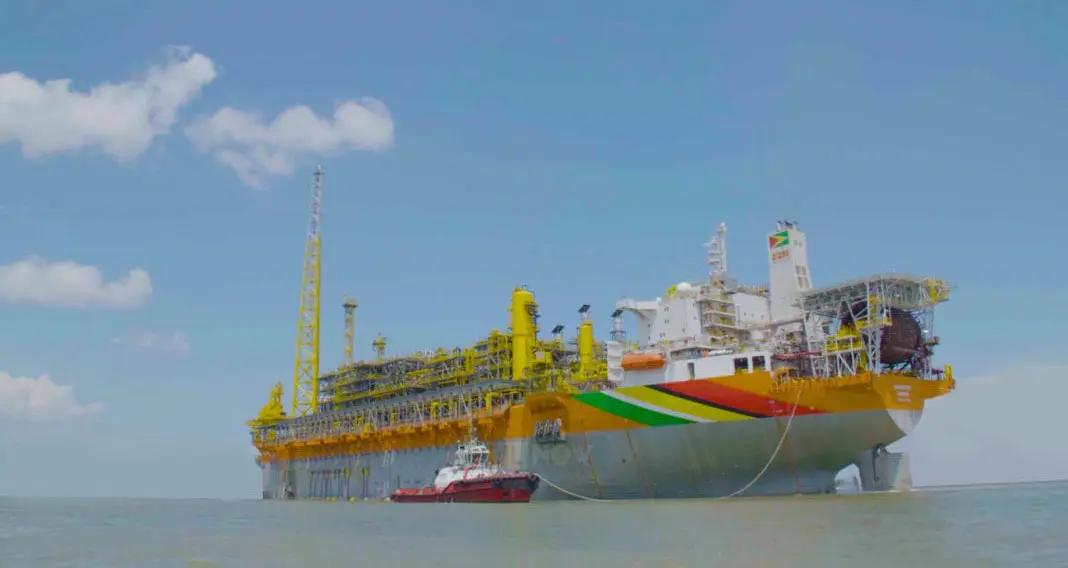
The President’s remarks came as he announced that the Errea Wittu, Guyana’s fifth floating production, storage and offloading vessel (FPSO), is expected to arrive offshore this week. The vessel departed Singapore earlier this month and first oil from the Uaru development is targeted for the fourth quarter.
Built by MODEC, the Errea Wittu is designed to produce approximately 250,000 barrels of oil per day and store around two million barrels. Its commissioning is expected to push Guyana’s production above one million barrels per day for the first time.
The four operating FPSOs—Liza Destiny, Liza Unity, Prosperity and One Guyana—are currently producing between 900,000 and 920,000 barrels per day, Ali said.
Turning to the revenue arrangement, the President said up to 75% of production had previously been allocated to cost recovery. The remaining 25%, known as profit oil, was divided equally between Guyana and the Stabroek Block contractors.
Under that scenario, Guyana received 12.5 barrels from every 100 barrels produced as its half of profit oil, in addition to the 2% royalty payable under the agreement.
Ali said only about 20 barrels out of every 100 are now being applied to costs, leaving approximately 80 barrels as profit oil.
“That which is left, which is called the profit oil, is split evenly between Guyana and the companies,” he said.
According to the President, Guyana’s portion is now approximately 39.8 barrels out of every 100, while the contractors’ corresponding share is divided among ExxonMobil, Chevron and CNOOC.
The President cautioned that the cost bank had not disappeared. Although the reported US$55 billion in accumulated expenditure had been recovered, operating expenses and expenditure on additional developments would continue to be charged to the block.
Kiskadee Watch reported earlier this month that the announcement of the US$55 billion recovery raised questions about how much production should continue to be assigned to costs and whether the cost bank could increase again as the consortium invested in Uaru, Whiptail and other developments.
The publication explained that the frequently cited “50/50” division applies only to profit oil after allowable costs have been deducted. It does not mean that Guyana receives half of total production or half of gross petroleum revenue.
When the contractors claimed the maximum 75% for cost recovery, only 25% remained as profit oil. Guyana’s half of that residual was 12.5% of total production, which, when combined with the 2% royalty, produced the often-cited effective share of 14.5%.
With cost oil now said to have declined to around 20%, Guyana’s profit-oil entitlement has increased substantially without any amendment to the contract.
Kiskadee Watch reported that APNU oil and gas spokesperson Sharma Solomon had called for independent verification of ExxonMobil’s US$55 billion figure and disclosure of the costs which remain recoverable.
Solomon warned that the government should not accept the contractor’s accounting without verification or announce an arbitrary increase in Guyana’s take without audited production, revenue and expenditure figures.
The absence of ringfencing in the 2016 agreement allows costs from new projects and exploration across the Stabroek Block to be recovered from revenue generated by producing developments. Consequently, the percentage allocated to cost oil may fluctuate as new expenditure enters the accounts.
The government has faced longstanding criticism over incomplete or delayed audits of the consortium’s expenses and over the fiscal terms of the 2016 agreement, including the 2% royalty, the absence of ring-fencing and the provision under which the state pays the contractors’ income taxes from Guyana’s share.
Ali did not address those criticisms yesterday. He confined his remarks to explaining that the larger current allocation resulted from reduced cost recovery and not from a renegotiation of the agreement.
ExxonMobil affiliate Esso Exploration and Production Guyana Limited operates the Stabroek Block with a 45% interest. Chevron holds 30%, following its acquisition of Hess, while CNOOC Petroleum Guyana Limited holds the remaining 25%.











Discussion